14 Thanksgiving Kids Table Decor Ideas They Will Love
It’s 3:40 on Thanksgiving afternoon. The grown-ups are lingering at the big table, and the kids’ table is a wobbly card table in the corner with a paper plate on it.
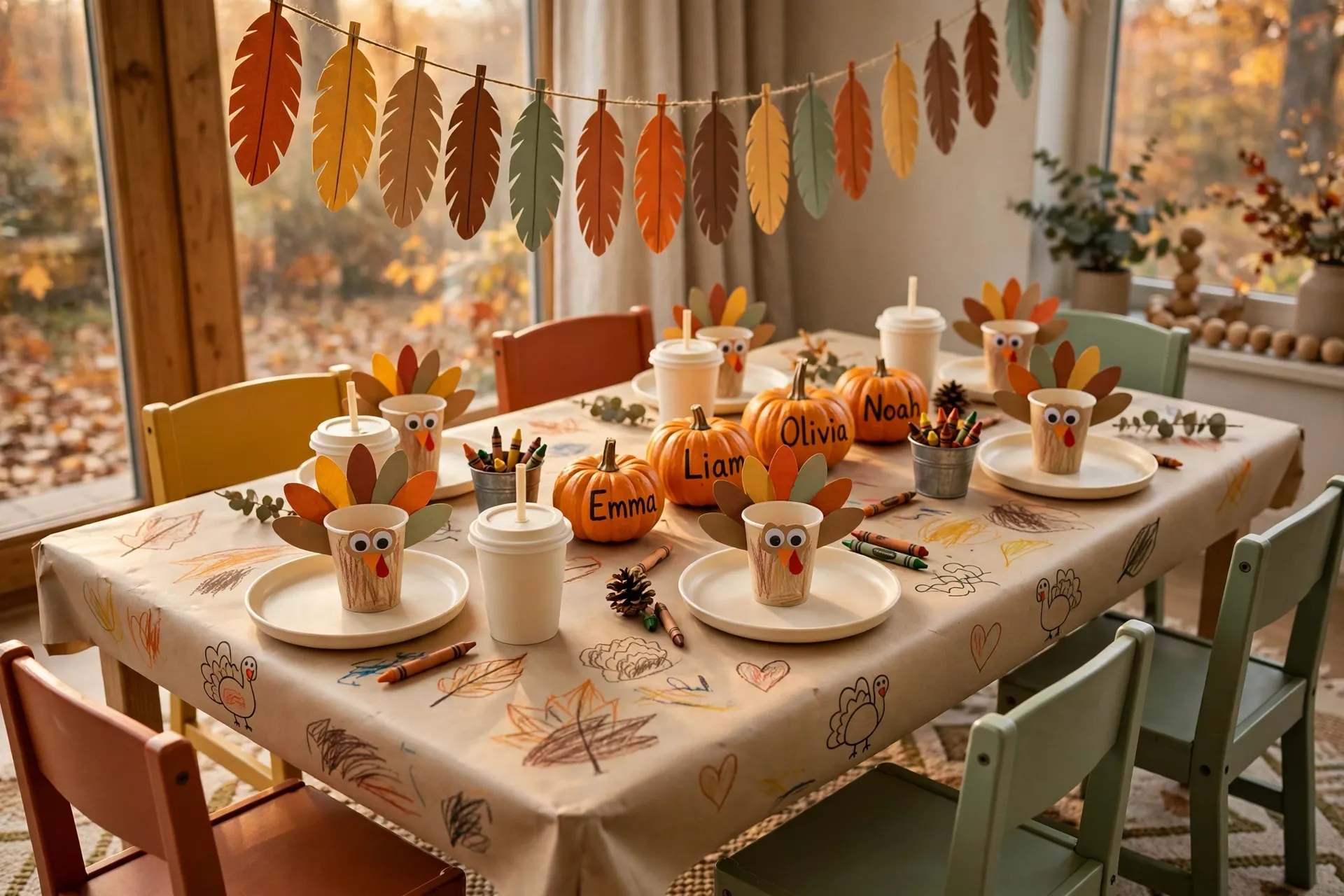
Now picture the other version. A roll of kraft paper covers the table. A cup of chunky crayons sits at every seat. A row of mini pumpkins wears each child’s name, and a paper feather garland hangs high overhead. The kids are drawing turkeys, and nobody has asked to leave the table.
That’s a kids’ table kids will love, and it’s easier than it looks. The decor does double duty as the activity, and the cleanup is one big roll-up.
Here’s the honest part. Many kids’ table posts are craft roundups, and several of the most popular ideas, such as popcorn-filled turkeys, bowls of nuts and candy, acorn turkeys with googly eyes, and balloons, are choking hazards for younger children. This article gives you ideas that work for the ages you’re hosting, plus safer swaps.
Thanksgiving falls on Thursday, November 26, so you have about two weeks. Below are 14 Thanksgiving kids’ table decor ideas, each with the reason it works, measurements where they help, and a safety note where one matters.
Quick answer: A great Thanksgiving kids’ table uses a paper tablecloth they can draw on, unbreakable tableware, one simple centerpiece, and an activity at every seat. Match the table height to the children’s ages (about 18 to 24 inches for kids’ tables, or a regular table with booster seats), keep an adult within sight, and skip choking hazards for children under 4: nuts, popcorn, whole grapes, hard candy, latex balloons, and small decorations.
Table of Contents
1. Butcher Paper Doodle Tablecloth

The fastest way to make a kids’ table feel special is to let them draw on it. Roll out kraft or butcher paper so it covers the table with a 6 to 8 inch overhang on each side, and tape the edges underneath so it doesn’t slide. Set a cup of chunky crayons at each seat, and draw a big circle in front of each chair so everyone knows where the plate goes. Write a few prompts in the middle, like Draw your favorite pie or What are you thankful for? It works because the table becomes the decoration and the activity, and when dinner is over, you roll it up and toss it.
2. Hand Turkey Placemats

Hand turkeys are the classic kids’ craft because kids are the decor. Trace each child’s hand on a sheet of paper, then turn the thumb into the head and the fingers into feathers. Let them color it, and add their name on the body. Cover each placemat with clear self-adhesive laminating sheets, or slip it into a clear placemat sleeve, so it wipes clean. Make them earlier in the week or as the first activity at the table. Each placemat becomes a keepsake, and you can write the year on the back.
3. Gratitude Coloring Placemats
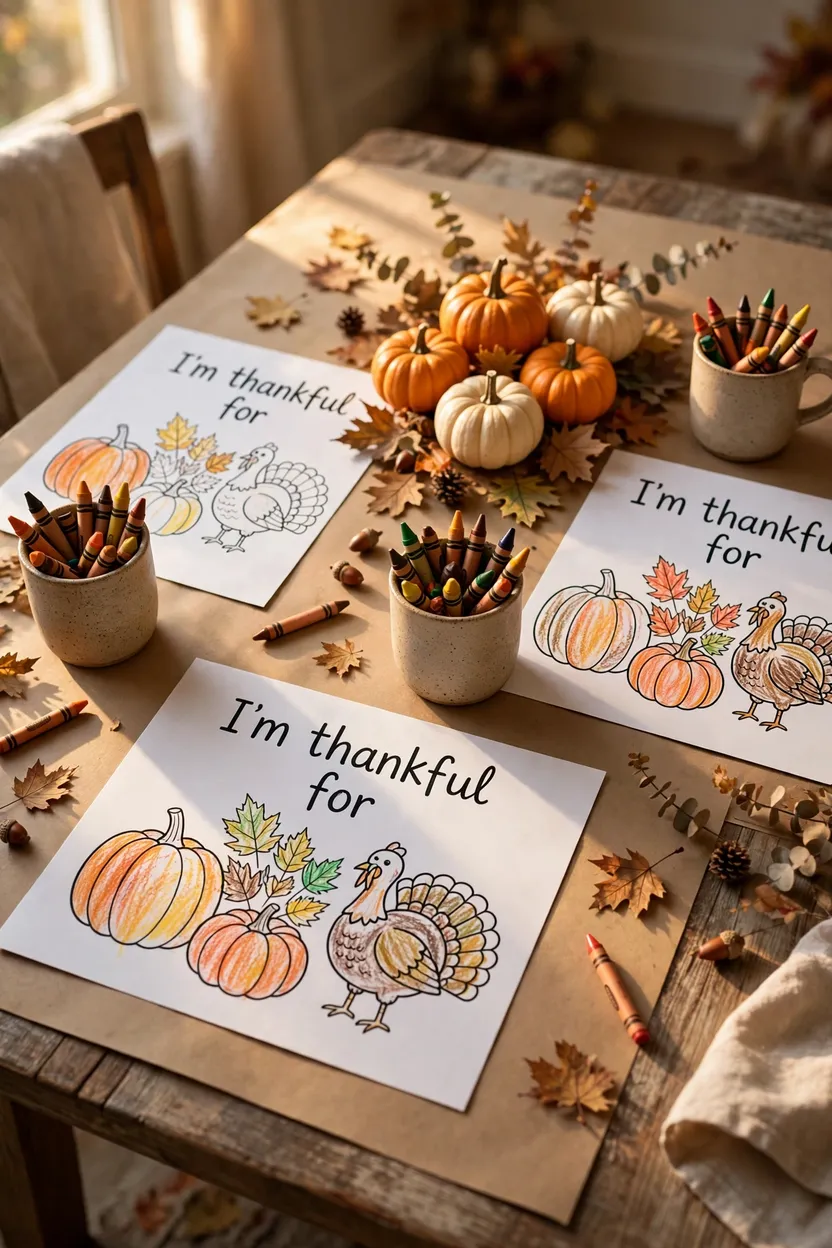
A coloring placemat with a prompt gives kids something to do and something to say. Print or draw a simple scene with a pumpkin, leaves, and a blank turkey, and add a line at the top that reads I’m thankful for. Use 11 by 17 inch paper so it fits under a plate, and set out nontoxic crayons. For little ones who can’t write yet, an adult can write their words for them. Use the same page for every child so the table looks coordinated, and tuck the finished pages into a folder as a keepsake.
4. Thankful Tree Centerpiece

A thankful tree turns a centerpiece into a gratitude game. Stand a bare branch about 12 to 16 inches tall in a metal can wrapped in kraft paper and weighted with sand, and cover the top with a paper circle so nothing spills. Cut paper leaves about 3 to 4 inches wide, and let kids write or draw what they’re thankful for before they hang them. For children under four, keep the tree on a wall or high shelf instead, and leave out small beads, pebbles, and long strings. It works because the tree fills up as the meal goes on, and it makes a sweet keepsake.
5. Sticker-Decorated Mini Pumpkins

Mini pumpkins are the easiest centerpiece, and kids can decorate them. Buy pumpkins about three inches wide, and set out large stickers and washable markers so each child can make their own. Write names on the pumpkins with a paint pen to double them as place cards. Nest the pumpkins in a shallow basket or a tray with a lip so they don’t roll off. Keep sticker sheets and small stickers away from toddlers, who may put them in their mouths. Mini pumpkins are sturdy, cheap, and can go home with each child.
6. Paper Cup Turkey Place Cards

A paper cup becomes a turkey in about two minutes. Turn an 8 to 10 ounce paper cup upside down, tape or glue paper feathers to the back, add a paper beak, and draw the eyes with a marker. Skip googly eyes and other small add-ons for kids under four. Write each child’s name on the cup’s belly and set one at each plate. Use glue sticks or tape for the kids, and keep hot glue for adults, away from the table. It works because the place card is also a craft, and the cost is pennies.
7. Crayon and Activity Cups at Every Seat

A small activity kit at each place keeps hands busy before the food arrives. Fill a sturdy cup with chunky crayons, a few large stickers, and a mini notebook, and write each child’s name on it. Choose chunky crayons for the youngest kids and washable markers for ages six and up, and keep marker and pen caps away from little ones. Tuck each cup into the circle you drew on the paper tablecloth so it doesn’t tip. Keep to three or four items per cup, so it feels special and not overwhelming. It works because every child has something of their own to do the moment they sit down.
8. Paper Feather Garland Overhead

A garland hung high brings color without taking up any table space. Cut paper feathers in rust, mustard, sage, and cream, and string them along twine in a gentle swag. Hang it well above the children’s reach, along a wall or across a window, and tape the ends securely. Keep strings and ribbons short and out of reach of young children, since cords can be a strangulation hazard. Keep the garland away from candles and hot light bulbs. Kids can help cut the feathers a few days earlier, and the garland makes the whole corner feel like a party.
9. Snack Cup Place Cards
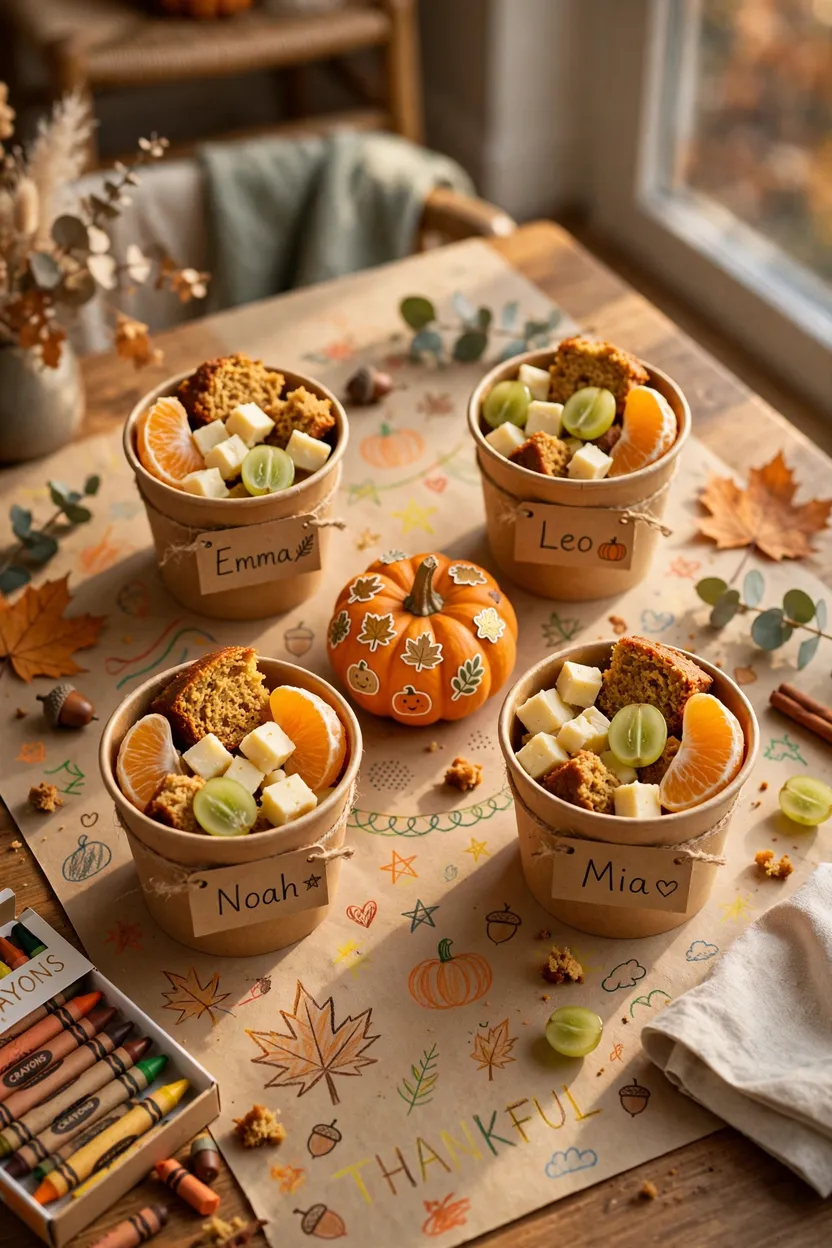
A snack cup at each seat is a place card and a pre-dinner treat in one. Fill small paper cups or muffin liners with age-safe snacks: soft cheese cut into small pieces, orange segments, grapes cut in half lengthwise (or quarters for toddlers), soft crackers, and small bites of pumpkin bread. Tag each one with the child’s name, and note on the card if the snack is nut-free. For children under four, skip nuts, popcorn, whole grapes, hard candy, and marshmallows, and have kids eat sitting down. It works because hungry kids settle faster, and the cups make the table look put together.
10. Leaf Rubbing Placemats

Leaf rubbings turn a walk outside into table decor. Collect flat, dry leaves, such as maple or oak, and wipe them clean. Lay each leaf under a sheet of paper, peel the paper off a crayon, and rub the side of the crayon over the leaf until the veins appear. Use the finished sheets as placemats or hang them on the wall behind the table. It’s a calm pre-dinner activity for ages four to ten, and an adult can peel the crayons for younger kids. It works because it connects the table to the season and costs nothing.
11. Kid-Sized Serving Station
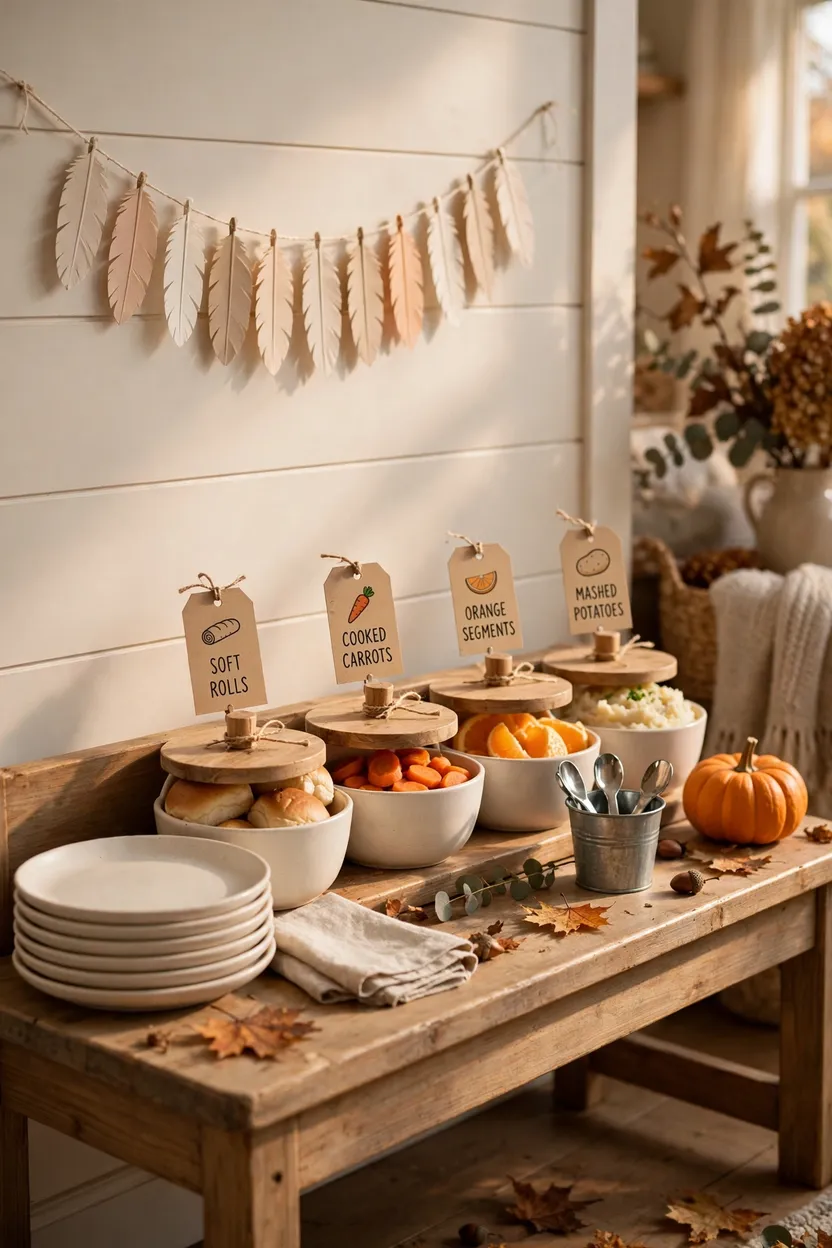
A low serving station near the dining area keeps the kids’ table calm. Set a low side table or a bench at the children’s height with child-sized plates, cups, napkins, and a few cold finger foods, so kids can serve themselves. Keep hot dishes with an adult, and offer small, soft portions: sliced turkey in small pieces, soft rolls, cooked carrots, cut fruit, and mashed potatoes in a covered dish. Label each dish with a simple picture sign. It works especially well when the kids’ table is already full of crayons and decor, and it teaches kids to help themselves.
12. Gratitude Question Jar
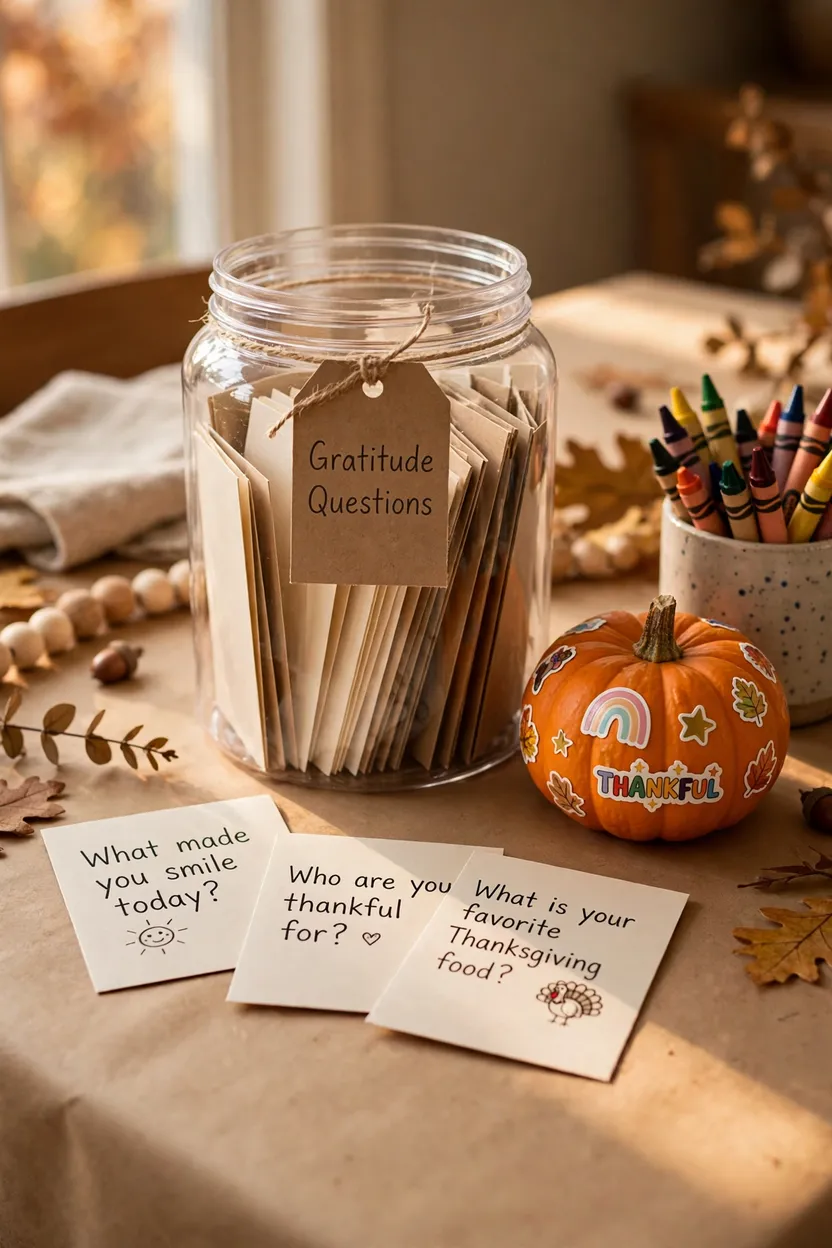
A jar of questions turns dinner into a conversation. Fill a plastic jar or a paper bag with 12 to 16 folded cards, each with a simple question in big print, such as What was the best part of your week? or Who are you thankful for? or What food could you eat all day? Let each child pick a card and answer. Add a few silly ones for tweens and teens, so they play along. Skip breakable glass at the kids’ table, and set the jar in the center. It works because it gives shy kids a turn and keeps loud kids on one topic.
13. VIP Kids’ Table Banner and Seat Signs

Sometimes all a kids’ table needs is to feel like the best seat in the house. Make a kraft paper banner that reads Kids Table or VIP Seating, and tape it to the wall behind the table. Give each child a seat sign with a fun job, such as Napkin Captain, Pie Inspector, or Gratitude Reporter, and tape it to the chair back or the table. Keep any ribbons or strings short and out of reach of little ones. It works because kids love being in charge of something, and the table becomes a team.
14. Mess-Proof Unbreakable Table Setting
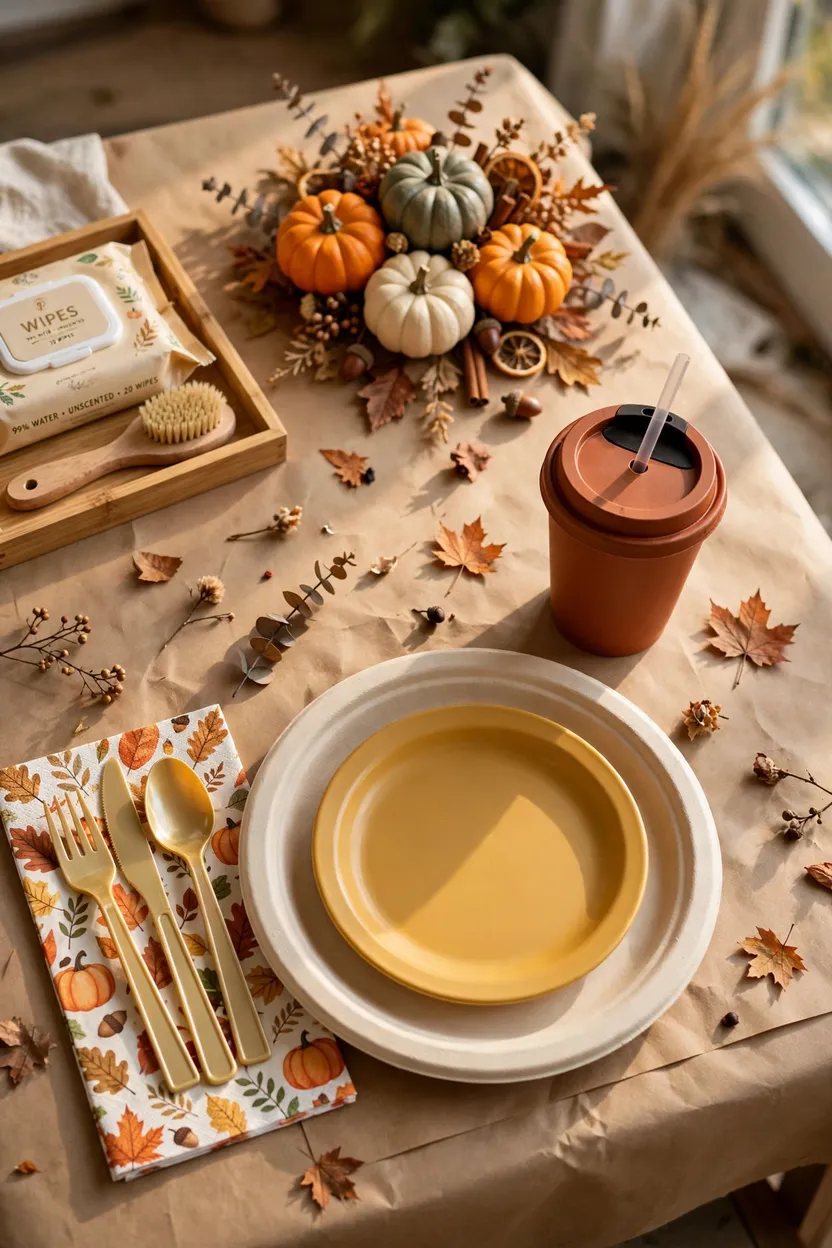
A kids’ table works best when nothing on it can break. Choose compostable or sturdy plastic plates in a palette like cream, rust, and mustard, plus lidded cups with straws, plastic or silicone flatware, and paper napkins. Skip glass, china, and anything with a sharp edge. Add a small tray with wipes, a handheld brush, and a trash bag at one end so cleanup is a minute, not an hour. Stick to one color palette so the table still looks pretty. It works because kids can relax, and adults can too.
Styling Tips for a Kids Table They Will Love
- Pick a three-color palette. Rust, mustard, and sage look cheerful and match most Thanksgiving tables.
- Echo the adult table. Repeat one color or pumpkin from the adult table so the two feel connected.
- Keep the centerpiece small. One tray of mini pumpkins is enough, and it leaves room for plates.
- Hang decor high. Garlands and banners go above the children’s reach, not on the table.
- Use their names. Names on pumpkins, cups, and signs make each child feel included.
- Make the activity the decor. Placemats, a paper tablecloth, and a thankful tree are decor and fun in one.
- Use odd numbers. Three pumpkins or five paper turkeys look better than pairs.
- Leave room to eat. Plan about 18 to 20 inches of table width per child, and keep decor out of the plate zone.
Practical Implementation Ideas
Before you buy anything, follow this order.
- Count the kids and their ages. The age mix decides the table height, the activities, and the safe snacks.
- Choose the table. Use a kids’ table for ages two to seven, or a regular table with booster seats for toddlers and older kids.
- Cover the table. Roll out kraft paper or a disposable cloth, and tape the edges under the table.
- Pick one centerpiece and one or two activities. Too many things crowd the table and the kids.
- Set unbreakable tableware. Use compostable or plastic plates, lidded cups, and plastic flatware.
- Plan the supervision. Place the table within sight of the adults, and name a table captain.
- Plan safe snacks. Make a list of what each child can eat, and check for allergies.
Kids’ Table Size Guide
| Age group | Table height | Seat height | Notes |
|---|---|---|---|
| Toddlers (1 to 3) | About 18 to 20 inches | About 10 to 12 inches | Use booster seats with harnesses at a regular table if they can’t sit steadily |
| Preschool (3 to 5) | About 20 to 22 inches | About 10 to 12 inches | Round corners and sturdy chairs help |
| Early school (5 to 7) | About 22 to 24 inches | About 12 to 14 inches | Good size for coloring and crafts |
| Older kids (8 to 12) | Standard 28 to 30 inches | About 15 to 17 inches | Use a card table with sturdy chairs or a spot at a regular table |
| Any age | Seat to tabletop gap about 8 to 10 inches | Width of about 18 to 20 inches per child | Rule of thumb, adjust for your table |
Safe Swaps by Age
| Common idea | Why to skip it for under 4 | Use this instead |
|---|---|---|
| Popcorn-filled turkeys | Popcorn is a choking hazard | Paper cup turkeys, or cups of soft fruit pieces |
| Bowls of nuts and candy | Nuts and hard or sticky candy are choking hazards | Soft cheese cubes, orange segments, and pumpkin bread |
| Whole grapes | Round, firm foods can block the airway | Grapes cut lengthwise in half or quarters |
| Latex balloons | Broken or uninflated balloons are a serious choking risk | Paper garlands or paper lanterns |
| Googly eyes, acorns, beads, and pebbles | Small parts can be swallowed or inhaled | Drawn eyes, large paper shapes, and large wooden pieces |
| LED tea lights with button batteries | Button batteries are dangerous if swallowed | No candles on the kids’ table, or lights with sealed battery covers kept out of reach |
| Long ribbons and strings | Cords are a strangulation hazard | Short, secure ties hung out of reach |
Always have children eat sitting down, supervise older kids who might share food with younger ones, and check with your pediatrician about foods for your child. This is general guidance, not medical advice.
Your 13-Day Plan to Thanksgiving (November 26)
| Dates | What to do |
|---|---|
| Friday, November 13 to Sunday, November 15 | Count the kids and their ages, choose the table, and write a supply list |
| November 16 to 19 | Buy kraft paper, crayons, cups, mini pumpkins, and unbreakable tableware, and print the placemats |
| Friday, November 20 to Sunday, November 22 | Craft with the kids: hand turkeys, paper feathers, a banner, and thankful tree leaves |
| Monday, November 23 and Tuesday, November 24 | Test the table height, check the seating, finalize the snack list and allergy notes, and buy fresh fruit and cheese |
| Wednesday, November 25 | Set the table, tape the paper, add place cards and activity cups, and hang the garland high |
| Thursday, November 26 | Add the snack cups and cold finger foods, put the crayons out last, and name a table captain |
These are common starting points, not strict rules. Adjust them for your kids, your table, and your family.
Common Mistakes to Avoid
- Using choking hazards with young kids. Popcorn, nuts, whole grapes, hard candy, latex balloons, and small decorations are risky for children under four.
- Using real china or glass. One dropped plate ruins the mood. Use unbreakable tableware only.
- Hanging decor low. Garlands, strings, and banners belong out of reach.
- Skipping supervision. Even a cute kids’ table needs an adult within sight and one clear table captain.
- Choosing the wrong table height. A table that’s too tall or a chair that’s too low makes kids slide, slump, and spill.
- Overloading the table. Too many crafts leave no room for plates, so pick one centerpiece and one or two activities.
- Forgetting allergies. Ask parents about allergies, and label snack cups clearly.
- Using candles on the kids’ table. Leave real candles and button-battery lights off the kids’ table.
- Putting out markers too early. Set out the crayons last, so the paper stays clean until the kids arrive.
- Forgetting cleanup supplies. Keep wipes, a trash bag, and a handheld brush within reach.
Small-Space Alternatives
- Use a coffee table. Kids can sit on the floor on pillows with a kraft paper cover and crayons.
- Use the end of the adult table. Add booster seats and a paper placemat for each child.
- Fold out a card table. It’s about the right size for four, and it stores flat.
- Use a tray table or lap tray. For toddlers, a tray with a lipped edge keeps food contained.
- Hang the garland on a wall. It adds color without using table space.
- Skip the centerpiece. A cup of crayons and one pumpkin at each seat is enough.
Budget-Friendly Alternatives
- About $15: A roll of kraft paper, a pack of chunky crayons, a few mini pumpkins, and paper cups.
- About $30: Add compostable plates, lidded cups, large stickers, and a paint pen for names.
- About $50: Add a paper feather garland, extra craft supplies, and a small kid-height serving tray.
- Reuse what you have. Shoe boxes, paper bags, and scrap paper make great crafts.
- Craft with the kids. Kids’ own placemats, leaves, and turkeys cost nothing and mean more.
- Shop after the season. Fall paper goods and mini pumpkins are often marked down right after Thanksgiving, so save the leftovers for next year.
No-Prep Alternatives
Short on time? You can still set a happy table in 15 minutes.
- Roll out the paper. A kraft paper roll takes two minutes.
- Set a cup of crayons. One cup in the middle works for four kids.
- Add three mini pumpkins. They’re centerpiece, place card, and decor in one.
- Print a coloring page. Print one pumpkin page per child.
- Put out a snack plate. Soft cheese cubes, orange segments, and halved grapes keep little hands busy.
Pro Styling Recommendations
- Match one color from the kids’ table to the adult table, such as the same rust or the same pumpkin.
- Keep the centerpiece low and flat, so no one has to peer over it.
- Let the kids’ art be the highlight, and hang the best pieces on the wall afterward.
- Give older kids and teens a job, like table captain or photographer, so they feel included.
- Use one type of tableware in one palette, so the table looks calm even when it’s busy.
- Take a photo of the finished table before the kids sit down, since it will look different in five minutes.
Final Thoughts
A great kids’ table isn’t about perfect decor. It’s about giving kids a place that feels like theirs, with something to draw, something to eat, and something to be proud of.
Start with the ages and the table height. Cover it with paper, set out the crayons, keep the decor high and the dishes unbreakable, and skip the choking hazards for the little ones. Then let the kids make most of the decor themselves.
At 3:40 on Thanksgiving afternoon, you’ll look over and see a table of kids leaning over a drawing, and not one of them will ask to leave. That’s the best sign you got it right.