20 Small Pool Design Ideas That Feel Like a Real Resort
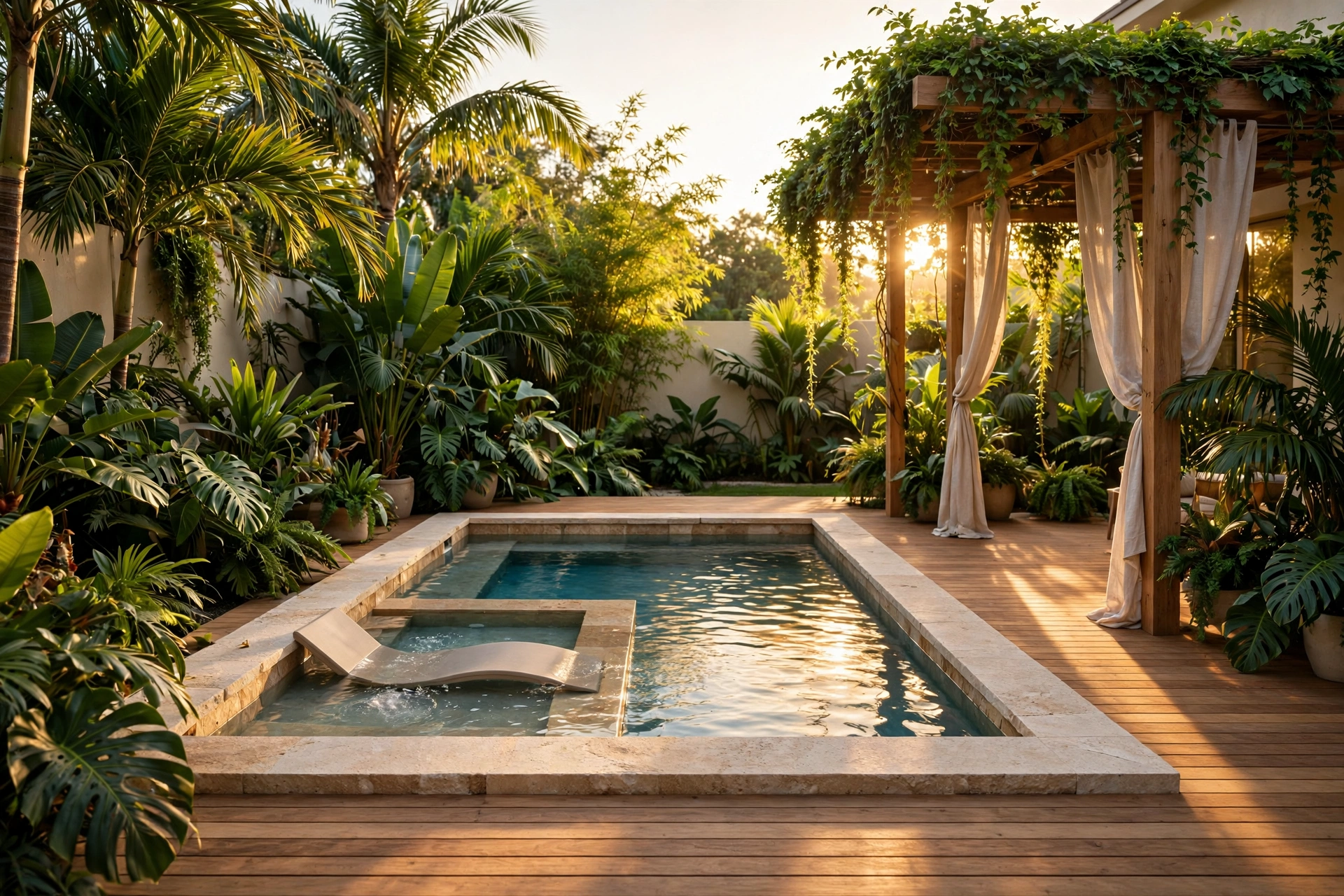
You don’t need a sprawling backyard or a five-figure landscaping budget to get that unmistakable resort feeling, the still water, the layered greenery, the sound of a small waterfall, the spot to stretch out with a drink in hand. What actually creates that feeling has very little to do with square footage and everything to do with a handful of smart choices: the right pool shape, one or two water features, and a deck designed for lounging, not just swimming. A small pool, done well, can feel more considered and more luxurious than a much larger one thrown in without a plan. These 20 ideas cover the pool itself, the water features that do the most visual work, and the surrounding space that turns a simple plunge pool into a genuine backyard escape.
Table of Contents
1. Go Minimalist With a Rectangular Concrete Plunge Pool
A clean, rectangular plunge pool in smooth concrete is one of the most reliable ways to get a resort feeling in a small footprint, since its simplicity is exactly what reads as intentional and high-end rather than an afterthought squeezed into leftover yard space. Pair the pool with a flush wood deck, one that sits level with the coping rather than raised or edged with visible framing, so the eye reads the whole area as one continuous surface instead of a pool interrupting a patio. This shape also maximizes actual swimmable space for its footprint compared to a curved or freeform design, which matters when every square foot of a small yard is doing double duty. Keep the surrounding materials limited to two or three, concrete, wood, and one stone accent, since a minimalist pool loses its calming effect the moment too many textures compete around it. This approach works especially well for a modern or contemporary home, where clean lines already define the architecture.

2. Tuck a Pool Into an Unused Corner With Layered Greenery
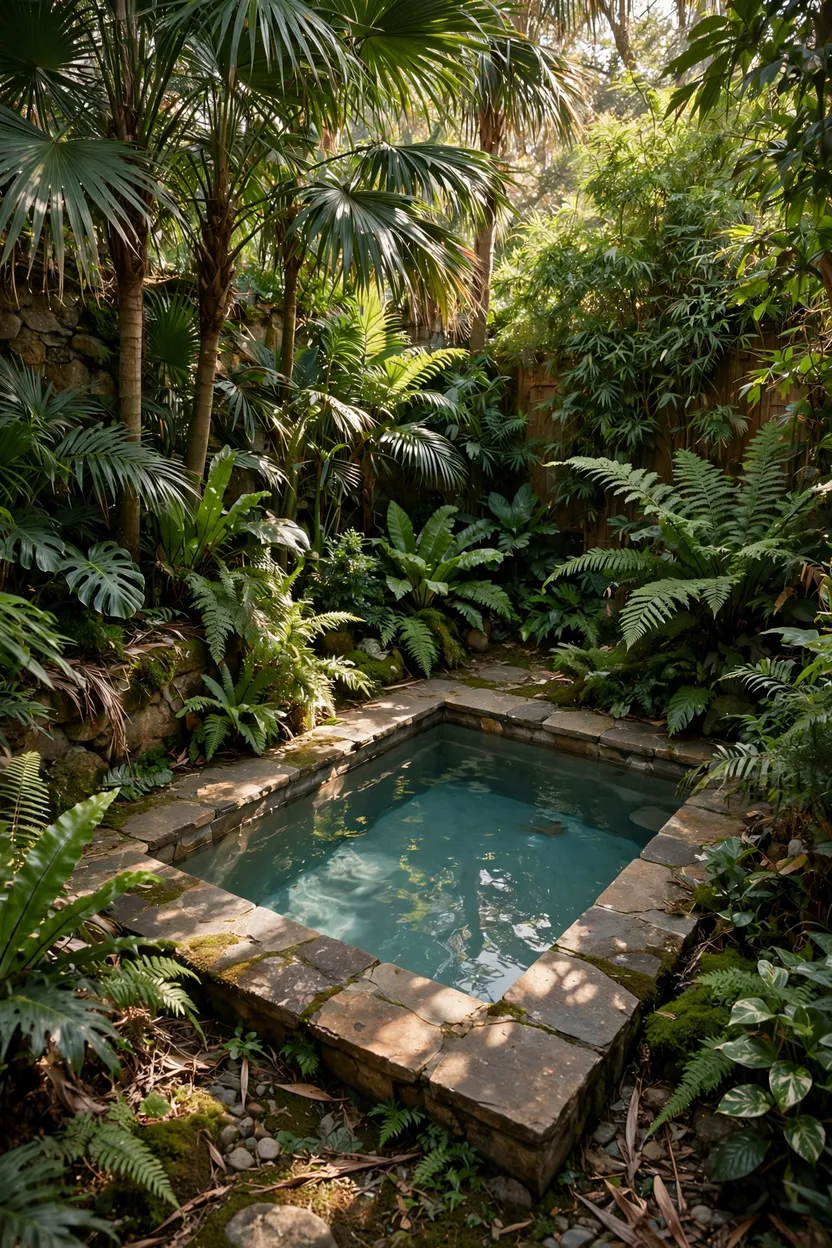
Positioning a small pool in a backyard corner, rather than centering it in the yard, is one of the smartest space-saving moves for a genuinely tight lot, and it comes with a built-in bonus: two sides of the pool can back directly onto layered landscaping instead of open fence line. Mixing plant heights and leaf textures along those two sides, tall palms or bamboo at the back, mid-height ferns or philodendrons in front, creates a natural sense of privacy and depth that makes the whole space feel larger and more secluded than its actual dimensions. Natural stone coping around the pool’s edge ties the hardscaping to the organic planting, keeping the transition between water and greenery from feeling abrupt. This layout works especially well in warm, humid climates where tropical plants thrive naturally, though cold-hardy varieties with a similar broad-leaf look can recreate the same effect in cooler regions. Because the landscaping does so much of the visual work here, this idea delivers a strong resort feeling even with a fairly modest pool budget.
3. Add a Built-In Tanning Ledge With Submerged Loungers
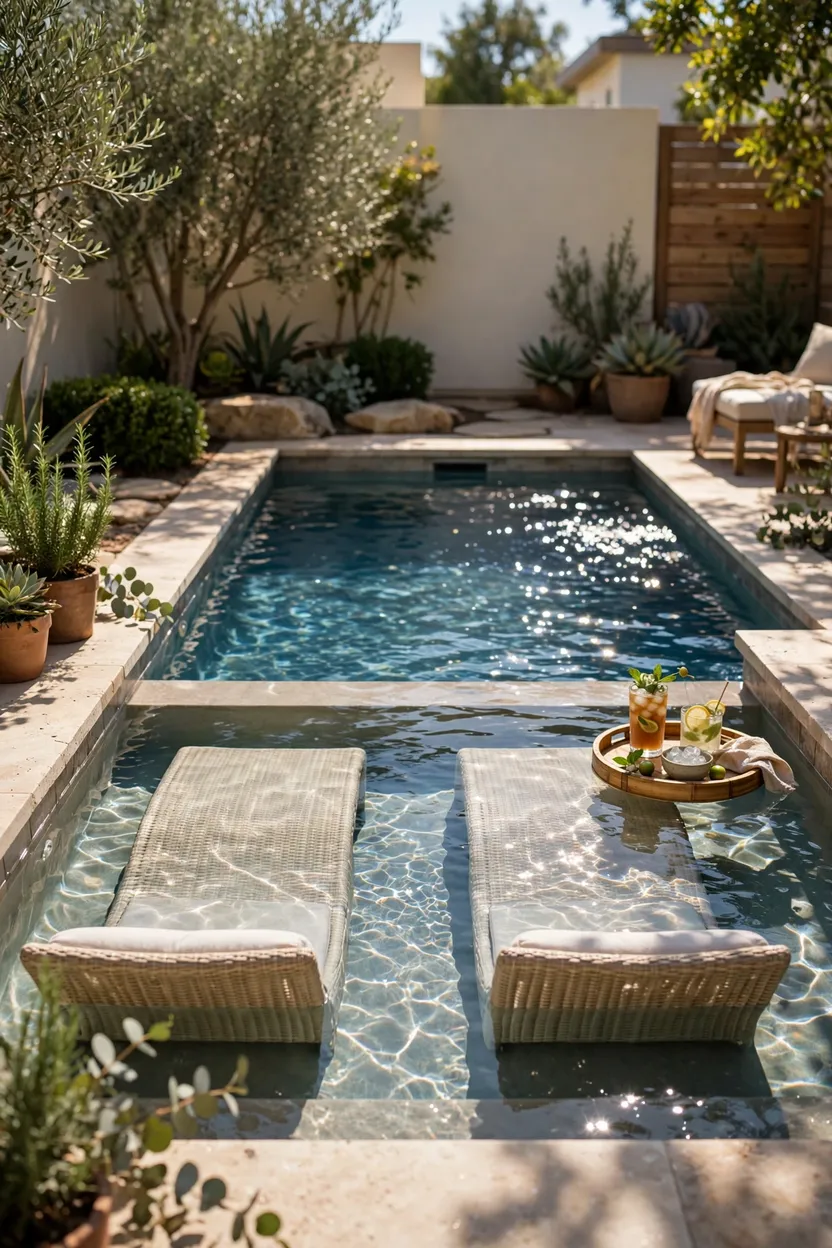
A tanning ledge, a shallow, wide step built into one end of the pool just a few inches underwater, gives you a resort-style lounging spot without adding any dry deck space, since the loungers themselves sit right in the water. This feature is a signature detail of high-end resort pools specifically because it invites a different kind of use than swimming laps or playing in the deep end, a spot to recline with your feet cooled by the water and a drink within reach. In a small pool, dedicating even a modest portion of the footprint to a tanning ledge is worth the tradeoff in swimming area, since it’s often the single feature guests remember most vividly. Add a small side table or a floating tray beside the loungers for drinks, and consider an umbrella positioned to shade the ledge during peak sun hours. This idea pairs especially well with a rectangular or freeform pool shape and works in nearly any climate warm enough to support a pool at all.
4. Combine a Spa and Plunge Pool Into One “Spool”
A spool, a compact combination of a small pool and an integrated spa, delivers two distinct resort experiences, a cool plunge and a hot soak, within a footprint barely larger than a single traditional pool would need on its own. This is one of the most space-efficient ways to add genuine luxury to a small yard, since it eliminates the need for two separate structures while still giving you the temperature contrast that makes resort spas feel so indulgent. Position the spa at one end with its own set of jets and a slightly raised or separated edge, so it reads as a distinct feature rather than simply a warmer section of the same pool. This setup extends the pool area’s usability into cooler months as well, since the spa portion can often be heated and used independently of the main pool. For a small yard with genuinely limited space, a spool frequently delivers more actual luxury per square foot than any single-purpose pool design could.

5. Add Deck Jets or Laminar Jets for Movement and Sound
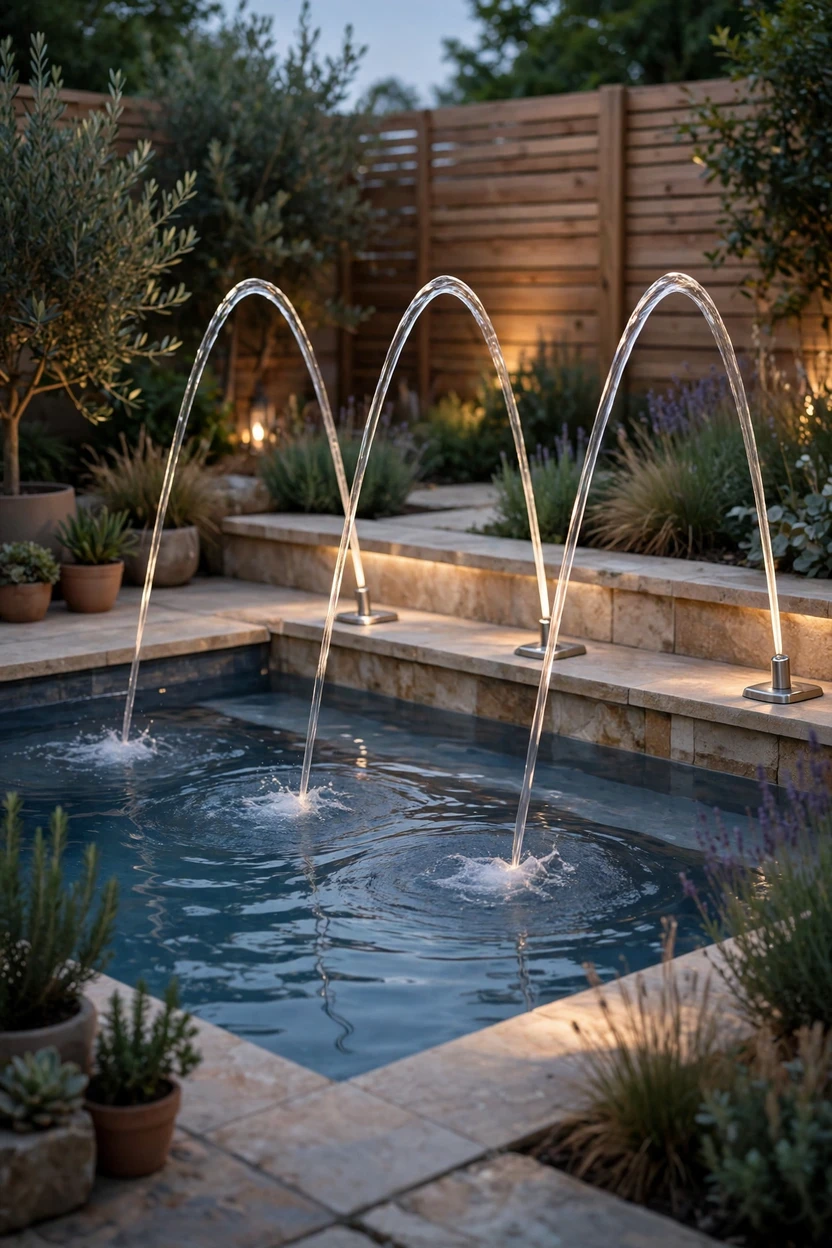
Deck jets, which arc streams of water from the pool’s edge into the surface below, and laminar jets, which produce precise, glass-like streams that hold their shape before splashing down, both add motion and sound to a small pool without requiring any additional square footage at all. These features are especially effective in a compact design because they draw the eye and the ear, giving the space a layered sensory quality that a still, quiet pool of the same size wouldn’t have on its own. Position a row of two or three jets along one edge of the pool rather than scattering them randomly, since a deliberate, evenly spaced line reads as more architectural and intentional. At night, laminar jets in particular can be lit from within to create a dramatic, illuminated arc of water, which is a detail borrowed directly from high-end resort pool design. Because these features require only plumbing and a pump upgrade rather than additional pool area, they’re one of the most efficient luxury upgrades available for a small pool.
6. Install a Cascading Water Wall
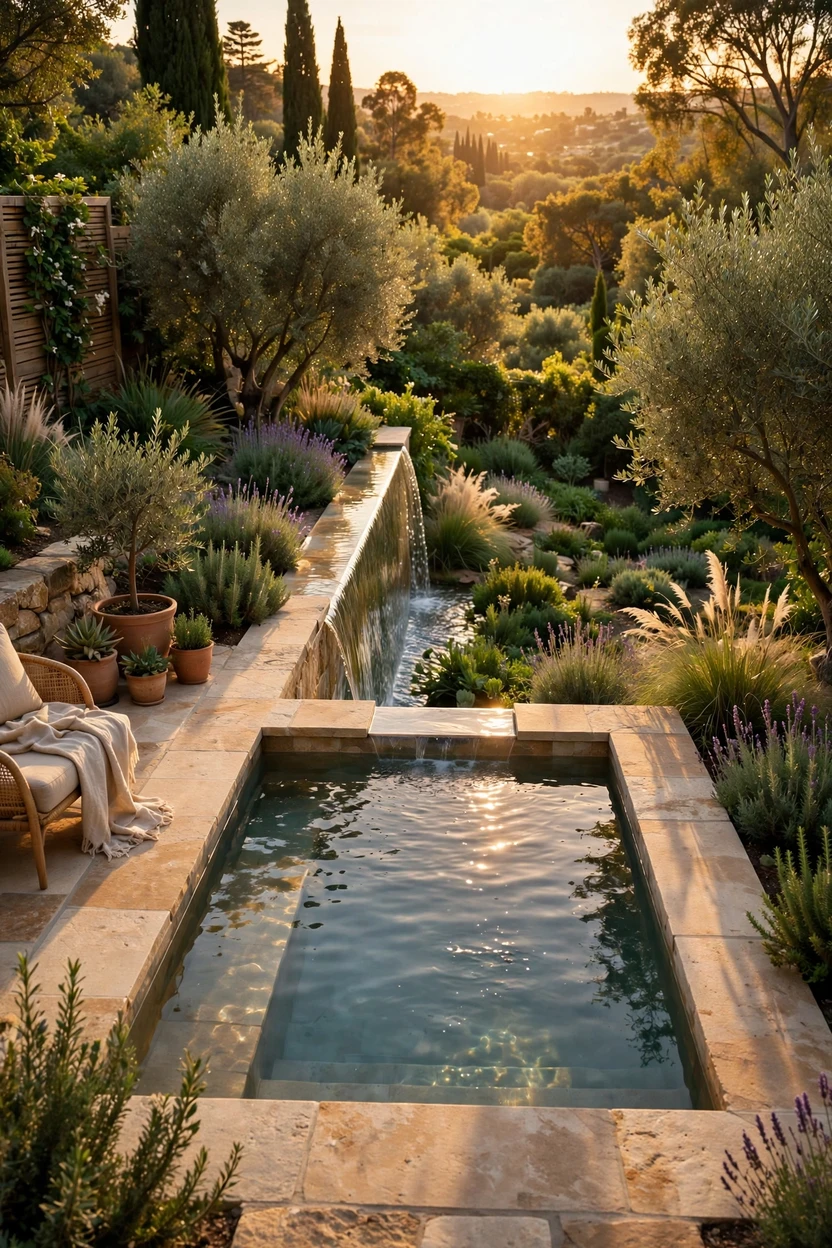
A vertical water wall or a stone waterfall feature positioned along one edge of a small pool introduces the sound of cascading water, one of the most consistently cited “resort” sensory cues, without requiring any of the pool’s own footprint to expand. Choose a wall height and water volume proportional to the pool’s scale, since an oversized feature can visually overwhelm a genuinely small space rather than enhancing it. Natural stone or a textured concrete finish on the wall ties the feature into the same material palette as the pool’s coping and deck, keeping the overall look cohesive rather than like a separate add-on. Positioning the wall so it’s visible from the home’s main windows or the primary lounging area maximizes its impact, since a water feature tucked out of sight loses most of its value. This is one of the higher-investment ideas on this list, but a well-built water wall consistently ranks among the features that most convincingly signal “resort” to anyone experiencing the space.

7. Pair Fire and Water for Dramatic Evening Ambiance
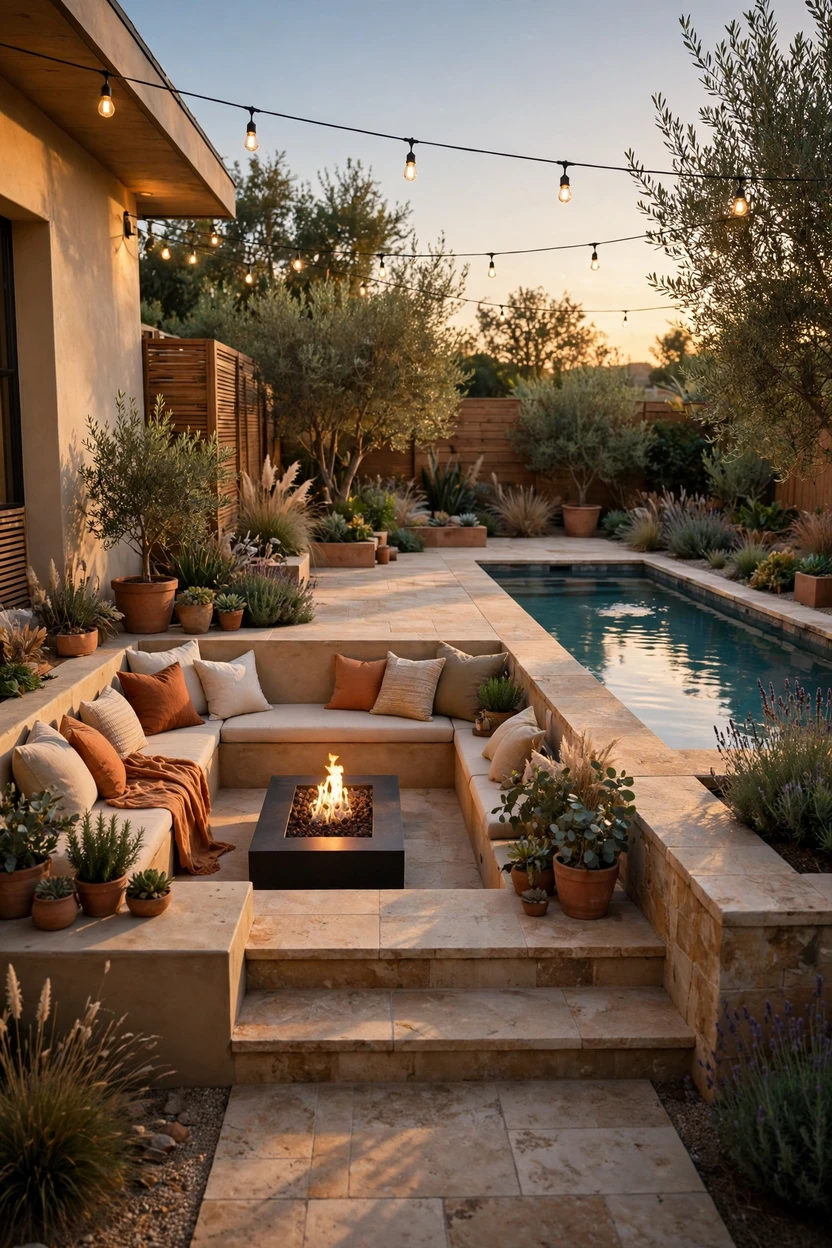
Fire bowls or a fire table positioned near the pool’s edge create a striking contrast against the water, and the combination of flickering flame and still or moving water is one of the most photographed, most consistently resort-coded design pairings in modern pool design. This feature works especially well in a small pool area because it adds a second focal point without requiring floor space beyond a compact fire bowl or table, and it extends the pool area’s usability into cooler evenings when swimming itself may not be on the agenda. Position fire features at a safe distance from overhanging plants or structures, and choose a fuel type, gas is generally easiest for a residential pool deck, that suits your local climate and any relevant regulations. Pairing a fire feature with built-in seating nearby creates a natural gathering spot that keeps the pool area active even after everyone’s finished swimming for the evening. This idea works in nearly any climate, since the fire feature’s appeal isn’t dependent on warm weather the way the pool itself is.

8. Choose a Glass-Walled Pool for Visual Depth
A pool with one transparent or partially glass wall, often built directly against a patio, basement window, or lower-level living space, creates a striking sense of depth and drama that makes even a genuinely small pool feel architecturally significant. Seeing into the water from the side, rather than only from above, is a design detail rarely found outside high-end resort and hotel pools, which makes it one of the most distinctive ways to signal luxury in a residential small pool build. This option is a more significant structural investment than most ideas on this list, generally requiring specialized acrylic or glass panels engineered to handle water pressure safely, so it’s best planned from the earliest stages of a pool build rather than retrofitted later. Positioning the glass wall to face an indoor living space, rather than only an outdoor view, doubles its impact, letting the pool become a visual feature from inside the home as well as outside. Underwater lighting paired with a glass wall extends the dramatic effect well into the evening.

9. Soften the Edges With a Freeform or Kidney Shape
A curved, freeform, or kidney-shaped pool trades the rigid geometry of a rectangular design for softer, more organic lines, which tends to read as more relaxed and naturalistic, closer to a lagoon or a natural swimming hole than a formal swimming pool. This shape can actually be more space-efficient than a straight-edged design in an irregular or oddly angled backyard, since the curves can be shaped to follow the lot’s existing boundaries rather than forcing a rigid rectangle into an awkward space. Curved pools also create more opportunities for varied landscaping along the edge, since the changing angle of the shoreline invites planting pockets a straight edge wouldn’t naturally offer. Pairing a freeform shape with natural stone coping and dense, layered plantings reinforces the organic feeling this shape is built around, while a starker, more minimal landscaping approach can also work if you want the curved shape to read as more modern than naturalistic. This is generally a better fit for a backyard with a relaxed, laid-back style than a strictly architectural or contemporary one.

10. Build a Sunken Lounge Area Beside the Pool
A sunken seating area, a conversation pit set a step or two below the main deck level, positioned right beside the pool creates an intimate, resort-style gathering spot that reads as far more considered than a standard patio set placed on the same flat surface as everything else. The change in elevation naturally defines the lounging zone as its own distinct space, separate from the pool deck’s walking paths, without requiring any additional walls or structures. Line the sunken area with built-in bench seating and deep cushions, then add a small fire feature or a low table at the center to complete the gathering-spot feel. This idea works especially well in a small yard because the sunken design uses vertical space, digging down rather than building out, to create a defined zone without actually expanding the footprint the pool area occupies. Positioning the sunken lounge within view of the pool, rather than tucked behind landscaping, keeps the whole space feeling connected as one cohesive resort-style zone.
11. Create the Illusion of an Infinity Edge
A true infinity edge pool requires a dramatic view and significant engineering, but a scaled-down version, a vanishing edge along just one side of a small pool, angled toward a garden bed, a lower patio level, or even a simple mirror-finish water feature, can create a similar sense of the water disappearing beyond the pool’s actual boundary. This technique works especially well for tricking the eye into perceiving more space than the pool physically occupies, since the edge where the water appears to vanish removes the visual “stopping point” that a standard pool wall creates. Even without a sweeping natural view, positioning the vanishing edge to face your most attractive landscaping, rather than a fence or a neighbor’s wall, maximizes the illusion’s effect. This is a more technically involved build than most ideas on this list, generally requiring a catch basin and recirculation system below the vanishing edge, so it’s worth discussing feasibility with a pool designer early in the planning process. Done well, this feature alone can be the single most resort-defining element of an otherwise modest small pool.
12. Choose Natural Stone Coping and a Flush Deck
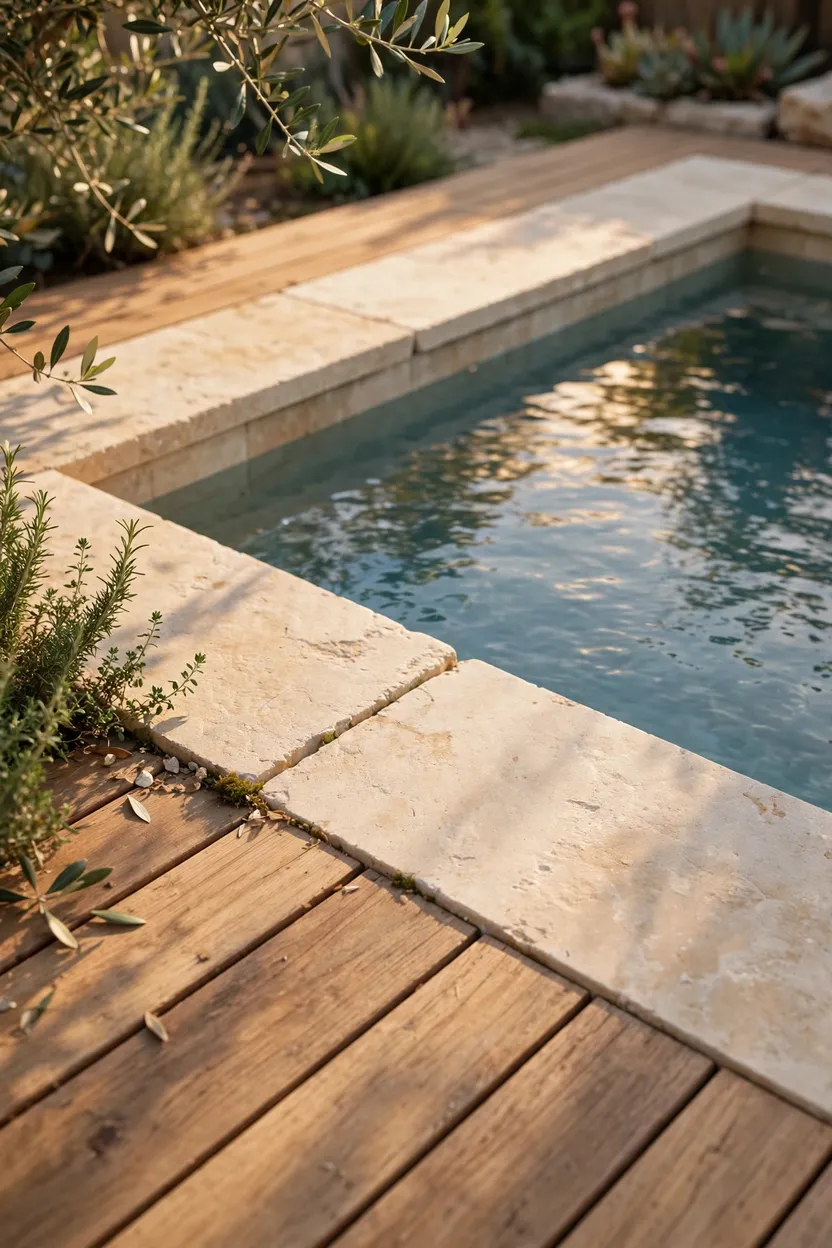
The material choices around a pool’s edge do as much to create a resort feeling as the pool itself, and natural stone coping, paired with a deck that sits flush with the water rather than raised or bordered by a visible lip, is one of the most consistently used details across genuinely high-end small pool designs. A flush deck removes the visual and physical barrier between water and walking surface, which makes a small pool area feel more open and continuous than a design with a raised, clearly separated edge. Choose a stone with texture for slip resistance, travertine and limestone are both common resort-pool choices, in a tone that complements rather than competes with your home’s existing exterior materials. This detail costs more than a standard poured concrete coping, but it’s frequently cited by pool designers as one of the highest-impact material upgrades available, precisely because it touches every single point where you interact with the pool. Keeping the stone consistent around the entire perimeter, rather than mixing materials at different points, reinforces the sense of a single, cohesively designed space.
13. Add a Vine-Topped Pergola With Drapery
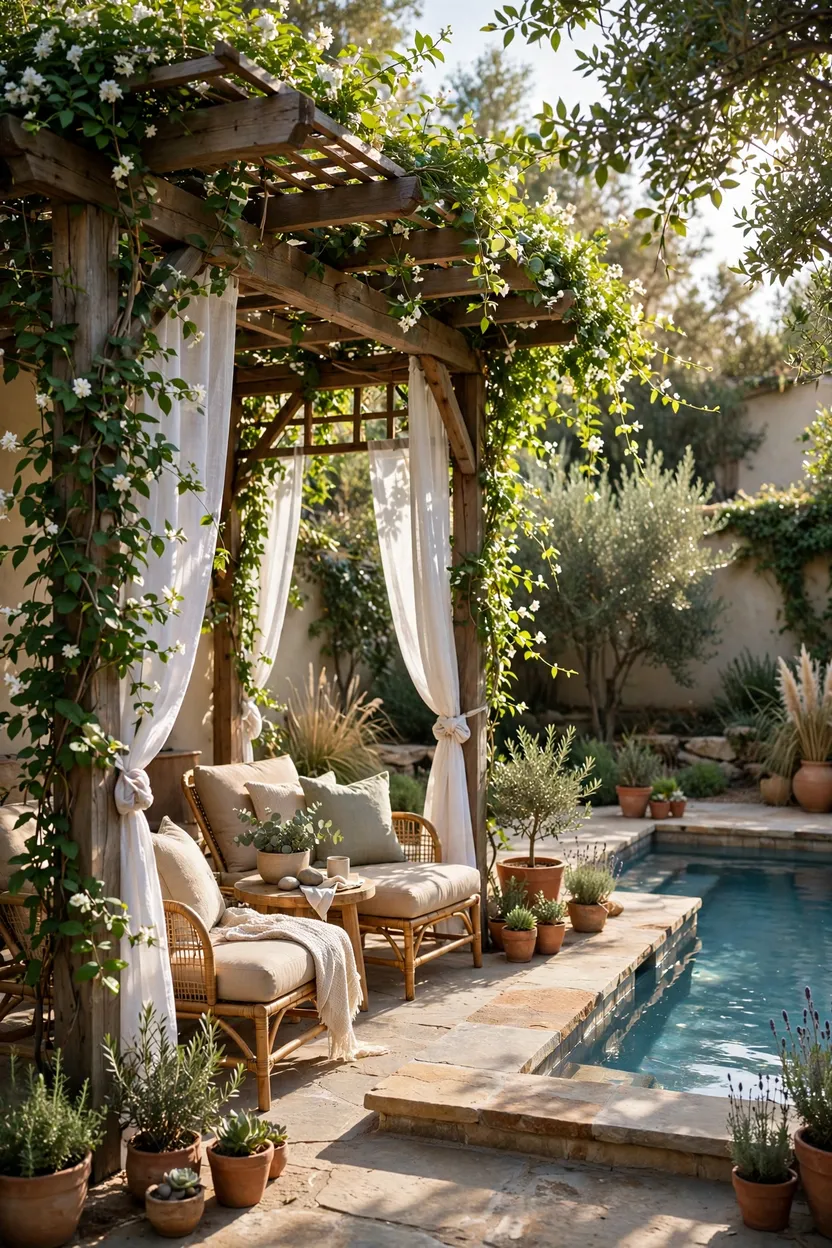
A pergola positioned beside or partially over the pool deck gives the space genuine shade and a defined architectural feature, while a climbing vine trained across its top and sheer drapery hung along the sides bring in exactly the kind of soft, breezy texture found at nearly every resort pool cabana. The drapery can be tied back during active pool time and drawn closed for shade or privacy later in the day, giving the structure real flexibility beyond a fixed shade sail or umbrella. Choose a fast-growing, climate-appropriate vine, wisteria, jasmine, or a flowering climbing rose, so the pergola fills in and starts delivering real shade within a season or two rather than staying bare indefinitely. Positioning a small dining or lounge set beneath the pergola extends the pool area’s usable hours well past direct sun exposure, turning the space into a place to linger rather than just swim and leave. This is one of the more moderate investments on this list and consistently ranks among the features that most visually signal “resort” in photos, since the combination of structure, greenery, and soft fabric reads as intentional and finished.
14. Layer in Color-Changing Underwater LED Lighting
Underwater LED lighting transforms a small pool after dark, giving it a soft, even glow that makes the water itself the primary light source for the whole backyard rather than relying entirely on overhead or landscape lighting. Color-changing fixtures let you shift the mood from a cool blue for a calm evening swim to a warmer tone for an evening gathering, adding a layer of flexibility that a single fixed light color can’t offer. This feature is relatively simple to retrofit into an existing pool compared to structural changes like a glass wall or a vanishing edge, making it one of the more accessible luxury upgrades on this list for a pool that’s already built. Positioning lights evenly around the pool’s perimeter, rather than clustering them at one end, ensures the glow reads as intentional and balanced rather than uneven. Paired with any of the water feature ideas above, laminar jets, a water wall, deck jets, lit water features multiply the overall nighttime drama of the space considerably.

15. Style a Stock Tank Pool Like an Intentional Feature
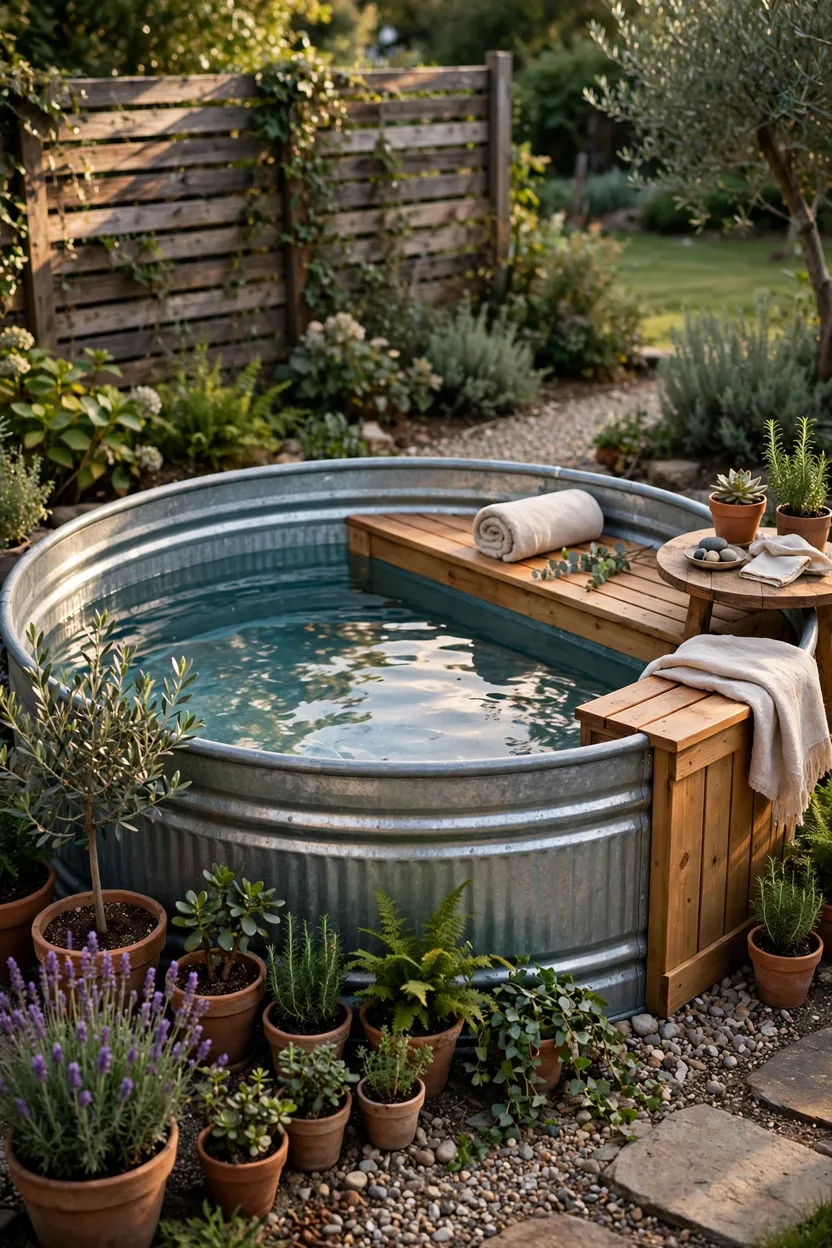
For a genuinely tight budget or a rented property, a galvanized stock tank pool, dressed up with a built-in wood bench, a small side table, and a designated spot for towels, can deliver a surprising amount of that resort feeling without the cost or permanence of an in-ground build. The key to making a stock tank read as styled rather than makeshift is treating it exactly like a small in-ground pool would be treated: define its edges with decking or gravel, add real seating nearby, and resist the urge to leave it as a bare metal tank sitting alone in the grass. Adding a simple filtration and heating setup, both widely available for stock tank pools specifically, makes the water genuinely comfortable rather than just decorative. Positioning the tank near existing landscaping, or adding a few potted plants around its base, ties it into the yard’s overall design rather than letting it read as a temporary object dropped into the space. This is by far the lowest-cost idea on this entire list and a strong option for anyone testing whether a permanent pool investment is worth making down the line.
16. Build a Rooftop or Elevated Plunge Pool
For an urban home with little to no ground-level yard, a rooftop or elevated plunge pool delivers a resort feeling that’s arguably even more dramatic than a traditional backyard pool, since it typically comes paired with an open sky view or a skyline backdrop that no ground-level small pool could offer. This is a significant structural undertaking, requiring an engineer’s assessment of the roof or platform’s weight capacity before any pool installation can move forward, so it’s a bigger investment and a longer planning process than nearly any other idea on this list. Choose a lightweight pool construction method, fiberglass shells and certain modular concrete systems are common choices for rooftop applications, specifically engineered for elevated installations. Surrounding the pool with wind screening, whether glass panels or dense potted greenery, matters more here than in a ground-level yard, since rooftop locations are typically far more exposed to wind. For the right property, this idea delivers one of the most genuinely unique, high-impact resort experiences available in a small footprint.

17. Design a Narrow Lap Pool for a Long, Slim Yard
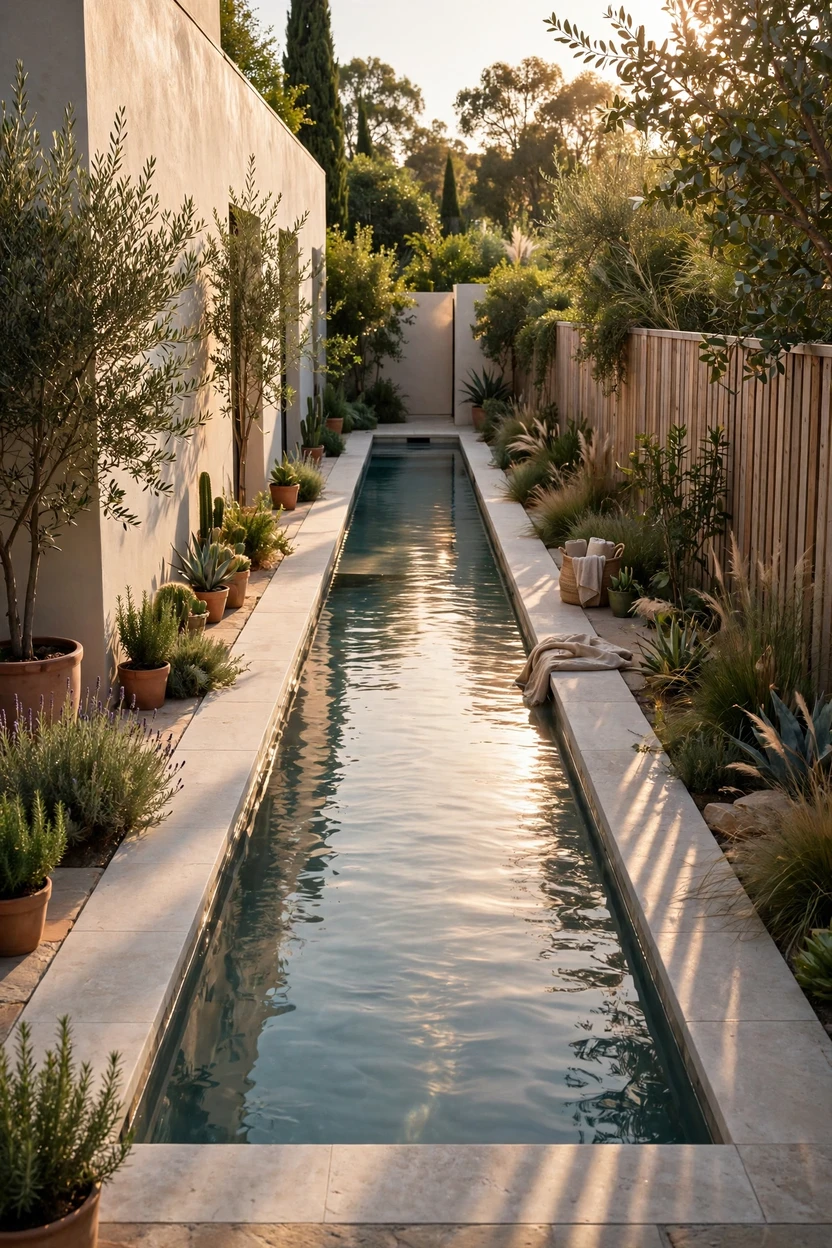
A lap pool, long and narrow rather than wide, is one of the most efficient shapes for a slim side or backyard, delivering genuine swimming distance in a footprint that a standard rectangular or freeform pool couldn’t fit into the same space. Beyond its practical exercise function, a lap pool’s elongated shape reads as architecturally striking on its own, especially when paired with a single, uninterrupted line of coping and decking running its full length. This shape works particularly well positioned along a property line or a narrow side yard, areas that often go entirely unused in a typical backyard layout. Adding a few water features or a single striking landscaping element at one end, rather than distributing them along the full length, keeps a lap pool’s clean linear feeling intact rather than visually cluttering it. For anyone who wants a pool that’s genuinely used for daily exercise as much as relaxation, a lap pool delivers both functions without sacrificing the resort-style visual impact this whole list is built around.
18. Integrate the Pool Flush Into the Patio as an In-Deck Design
An in-deck pool, built so its coping sits level with the surrounding patio surface across the entire perimeter, creates one of the most seamless, resort-hotel-style transitions available between the pool and the rest of the outdoor living space. This approach essentially treats the pool as one continuous surface with the patio itself, rather than a separate structure interrupted by a raised edge or a change in material, which visually expands how large the whole outdoor area feels even when the actual square footage hasn’t changed. This design tends to work best when planned from the very beginning of a patio and pool build together, since retrofitting an existing raised-edge pool into a flush in-deck design is a significantly larger project. Choose matching or closely coordinated materials for both the coping and the surrounding patio, since the entire effect depends on the eye reading no clear boundary between the two surfaces. This idea pairs especially well with the minimalist rectangular plunge pool and the natural stone coping ideas above, since all three share the same underlying goal of removing visual interruption around the water.

19. Add a Floating or Poolside Daybed
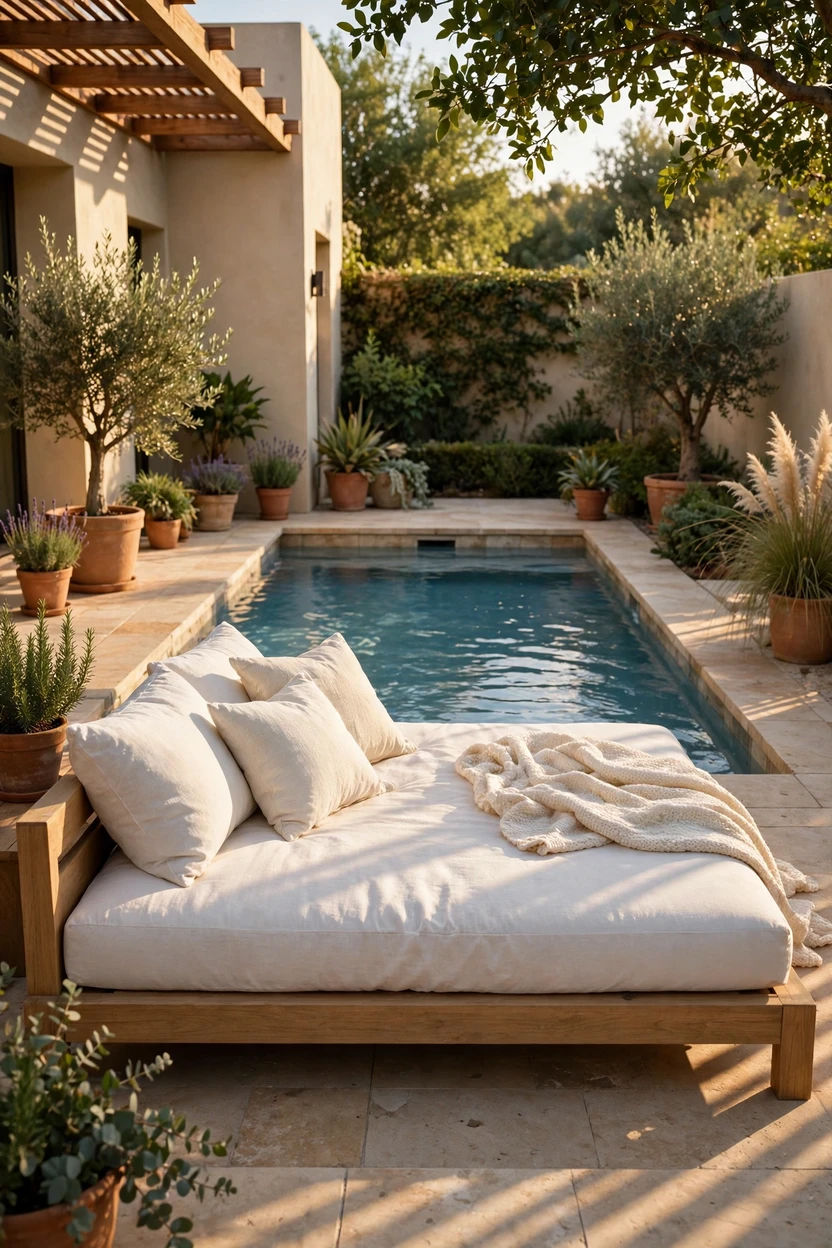
A wide, cushioned daybed positioned right at the pool’s edge, or a floating platform daybed anchored within the water itself, gives the space a singular, high-impact lounging feature that instantly reads as resort-level luxury, since it’s rarely found in a standard residential backyard setup. A poolside version works well on any deck with enough clear space for its footprint, while a floating platform daybed, increasingly available as a pre-built product, delivers an even more distinctive, hotel-pool-specific feel for a pool with adequate depth and calm water. Choose weather-resistant cushions and fabric specifically rated for pool and sun exposure, since standard indoor or even typical patio textiles won’t hold up to the combination of chlorine, sun, and moisture this close to the water. Positioning the daybed to face the pool’s most attractive feature, a water wall, the tanning ledge, or simply the open water itself, maximizes the payoff of what’s likely one of the more expensive furniture pieces in the whole space. This single feature is frequently the most-photographed element of small resort-style pools specifically because it looks so distinctly different from typical backyard pool furniture.
20. Add a Compact Outdoor Kitchen or Bar Nook
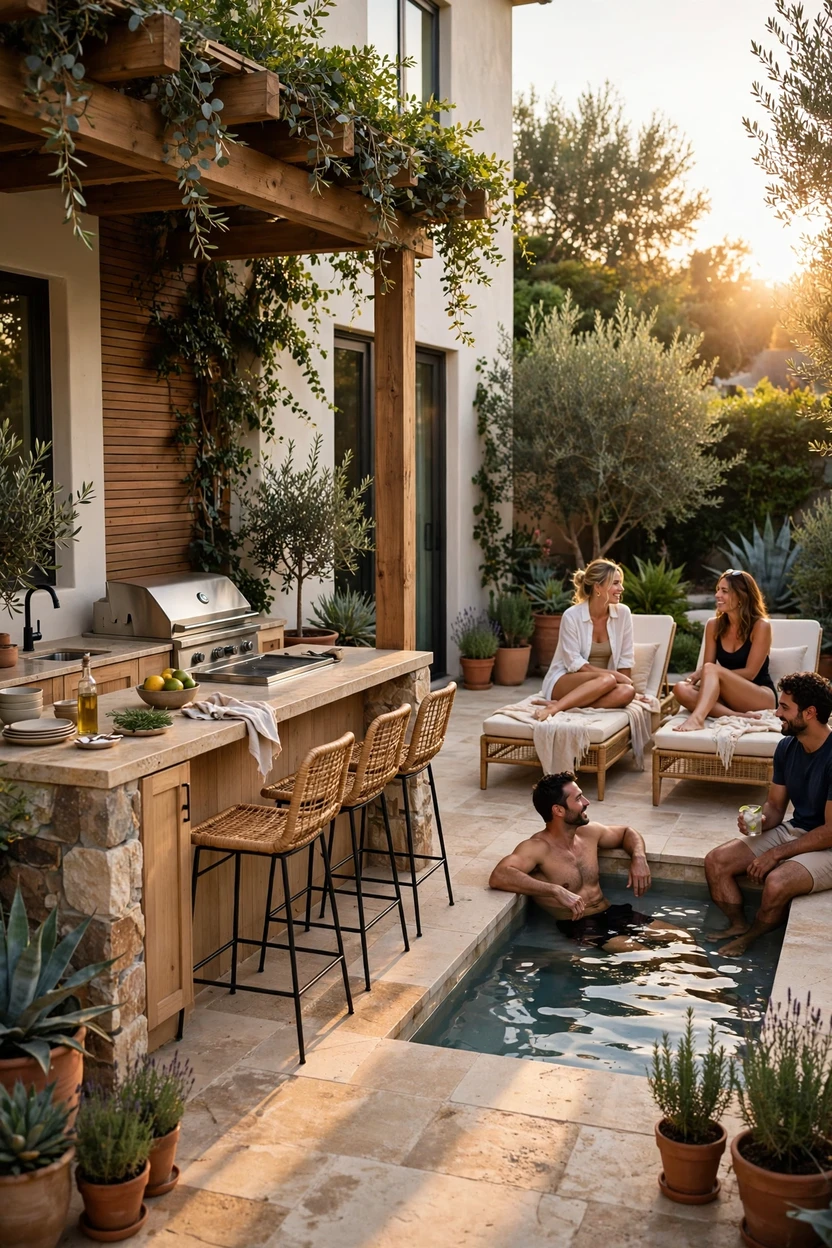
A small outdoor kitchen or a simple bar nook, even just a built-in counter with a mini fridge and a grill, positioned near the pool completes the resort feeling by giving the space a reason to gather beyond swimming itself, the same way a poolside bar anchors a hotel resort’s entire pool deck. This doesn’t need to be a full outdoor kitchen build to deliver the effect; a compact counter with a sink, a small refrigerator, and space for a few bar stools facing the pool covers most of what makes this feature work. Position it close enough to the pool deck that conversation flows naturally between swimmers and anyone at the counter, but far enough back that splashing water isn’t a constant concern for any electrical components. Choose weatherproof materials throughout, stainless steel, sealed stone, or weather-rated cabinetry, since this feature faces the same sun and moisture exposure as everything else on the pool deck. This is one of the higher-investment ideas on this list, but it’s also one of the features most likely to turn a small pool from a place you swim into a place you actually spend entire afternoons and evenings.
Styling Tips
- Limit the pool area’s material palette to two or three choices, concrete or stone, wood, and one metal or fabric accent, so a mix of ideas from this list still reads as one cohesive design.
- Choose one signature water feature rather than layering several at once; a single well-executed laminar jet or water wall reads as more intentional than a pool trying to do everything.
- Repeat plant varieties in clusters rather than a single specimen of many different types, since grouped, repeated greenery reads as more resort-like than a scattered plant collection.
- Add at least one piece of furniture, a daybed, built-in seating, a lounge chair, that’s clearly meant for lingering rather than just sitting briefly, since that’s what signals “destination” rather than “utility.”
- Layer lighting at more than one level, underwater, low path lighting, and one higher accent light like a pergola string light, so the space still feels finished and dimensional after dark.
Practical Implementation Ideas
- Confirm your local permitting, setback, and fencing requirements before finalizing any pool shape or size, since small-lot pools are often subject to specific regulations around property lines.
- Plan structural features like a vanishing edge, a glass wall, or an in-deck design at the very start of the build, since retrofitting these into an already-built pool is significantly more expensive and complex.
- Get a professional structural assessment before pursuing a rooftop or elevated pool design, since weight capacity is a hard requirement, not a design preference.
- Choose pump and filtration equipment sized appropriately for any added water features, since jets, waterfalls, and spa functions all add real demand beyond what a standard plunge pool’s system requires.
- Position shade structures and outdoor kitchen elements based on your yard’s actual sun path throughout the day, not just how they look in a reference photo, since afternoon sun exposure varies significantly by orientation.
Common Mistakes to Avoid
- Trying to fit too many features, a water wall, a fire feature, a tanning ledge, an infinity edge, into one truly small footprint, which usually results in a cluttered, competing design rather than a cohesive one.
- Choosing a pool shape based purely on trend photos without accounting for your yard’s actual dimensions and any awkward angles or existing structures.
- Skipping shade planning entirely, which leaves an otherwise beautiful pool deck unusable during the hottest parts of the day.
- Mismatching materials between the pool coping, the deck, and any surrounding structures, which undercuts the seamless, resort-like cohesion these designs depend on.
- Underestimating the ongoing maintenance a feature like a water wall, colored LED lighting, or a spool’s dual heating system requires before committing to the build.
Small-Space Alternatives
For a truly minimal footprint, a stock tank pool styled with real seating and a small water feature can deliver a meaningful amount of the resort feeling covered in this list without any in-ground construction at all. A compact plunge pool paired with just one high-impact detail, natural stone coping or a single laminar jet, rather than multiple features, also works well when space genuinely doesn’t allow for a fuller build-out.
Budget-Friendly Alternatives
A stock tank pool with a DIY built-in bench and simple string lighting delivers a strong resort feeling for a small fraction of the cost of an in-ground build. For an existing pool, adding underwater LED lighting and a single fire bowl near the deck are both relatively low-cost upgrades that significantly boost the evening resort atmosphere without any structural changes.
Pro Styling Recommendations
Pool designers who specialize in small residential builds consistently point to material cohesion, matching or closely coordinating the coping, decking, and any structures like a pergola, as the single highest-impact design choice, since it does more to create a seamless resort feeling than any individual water feature could on its own. The second most common recommendation is choosing one true signature feature rather than several competing ones, since a small pool with one well-executed focal point, a vanishing edge, a water wall, a tanning ledge, consistently photographs and lives better than one trying to include everything on this list at once.
Conclusion
A resort-style pool was never really about size, it’s about a handful of deliberate choices made consistently across the whole space: a clean shape, one standout feature, materials that match, and a spot designed for lingering rather than just swimming. Every idea on this list, whether it’s a full glass-walled build or a styled stock tank on a budget, is built around that same principle, and a small yard is honestly a better canvas for it than a sprawling one, since restraint reads as intentional at any scale. Start with the pool shape and material choices that fit your yard and budget, then layer in one signature feature and one real lounging spot before adding anything else. A small pool designed this way doesn’t feel like a compromise, it feels like exactly the kind of place you’d pay to visit.