
23 Mid-Century Modern Apartment Ideas With Architectural Appeal
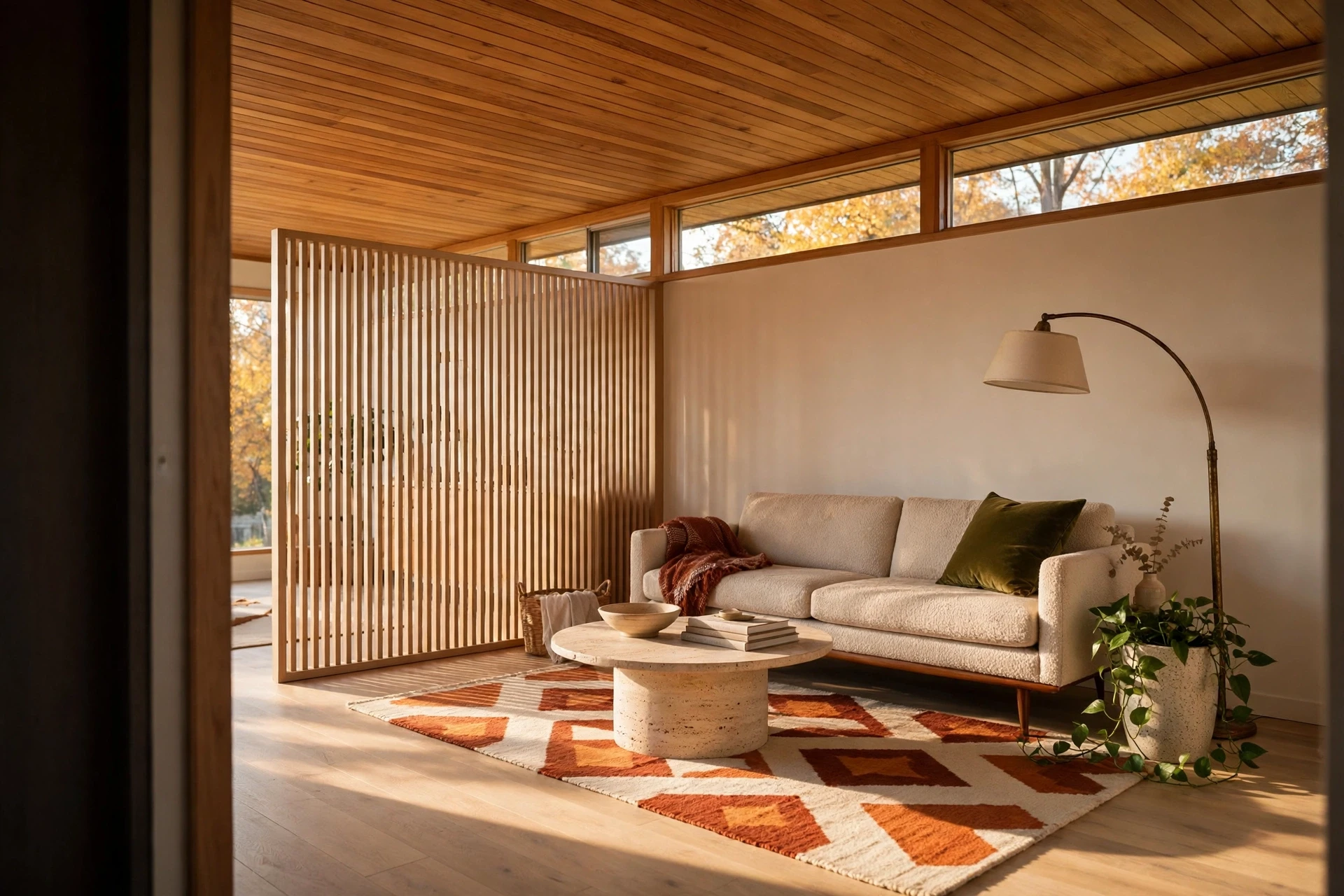
Picture this. You walk into a small apartment, and the first thing you notice is the ceiling. Honey-toned wood runs overhead. A thin strip of high windows lets in a clean, bright glow. A long walnut credenza stretches along the wall like it grew there.
That is the feeling behind the best mid-century modern apartment ideas. It’s less about buying an orange chair and more about lines, light and honest materials. Architects in the 1950s and 60s built homes with flat planes, wide glass, open floor plans and wood you could actually see. You can borrow those same moves in a rental.
This guide gives you 23 mid-century modern apartment ideas with real architectural appeal. Each one comes with the reason it works, a size or a color to aim for, and a way to make it fit a small space. Grab a coffee, open your Pinterest app and start saving.
Quick Answer: What Makes an Apartment Feel Mid-Century Modern?
A mid-century modern apartment borrows the building ideas of roughly the 1940s to early 1970s: horizontal lines, warm wood, lots of light and a calm, open layout. In a rental, you get there with low furniture, slatted wood, high-level light, brass details and a tight palette of warm neutrals plus one saturated color like olive, mustard, burnt orange or teal.
Quick Terms to Know
Mid-century modern (MCM): A design movement from about 1945 to 1975 that mixes organic curves with clean geometry, warm woods and a use-it-every-day attitude.
Related: 18 Modern Farmhouse Living Room Ideas With Texture & Warmth
Clerestory windows: A row of windows set high on a wall, close to the ceiling, that bring in daylight and keep eye-level wall space free.
Post-and-beam: A building method where posts and beams carry the roof, which lets walls be mostly glass and rooms stay open.
Breeze block: A pierced concrete block in repeating shapes like circles or diamonds, used for screens and walls.
Danish modern: The furniture side of the style, known for teak, soft curves and slim tapered legs.
Table of Contents
The 23 Mid-Century Modern Apartment Ideas
Warm Wood Plank Ceilings and Lightweight Faux Beams
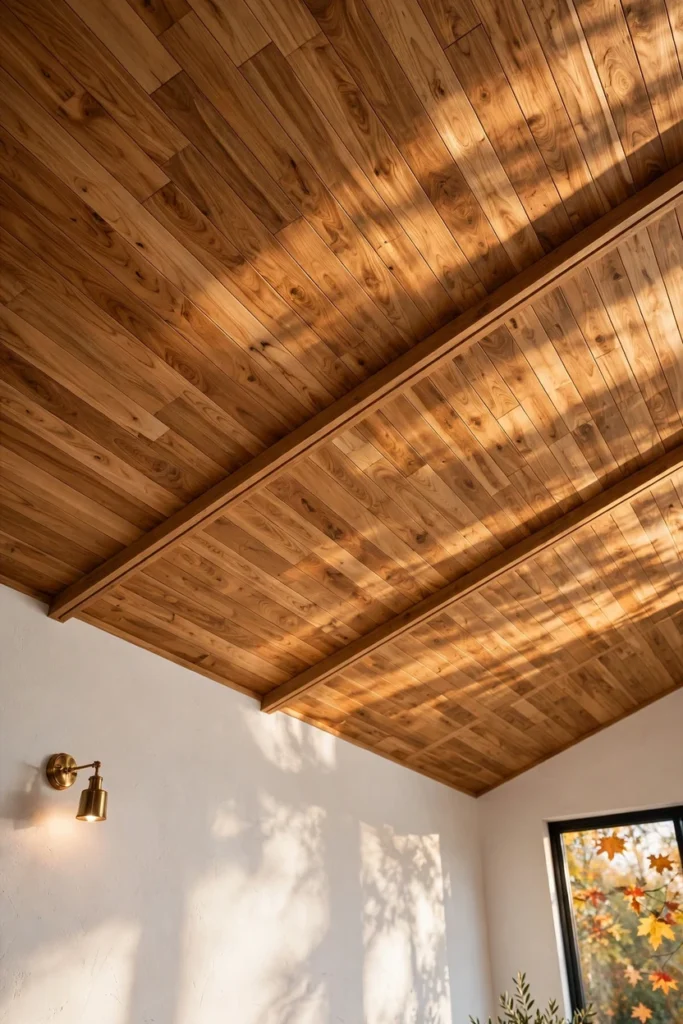
Mid-century architects loved to let the ceiling do some of the talking. Tongue-and-groove wood overhead made rooms feel snug and finished at the same time. In an apartment, you can echo that look with lightweight wood-look beams or a few plank panels above the sofa zone, as long as your lease allows it. Pick a warm tone like honey oak or walnut and keep the walls soft white so the wood is the star. A warm ceiling pulls the eye up, so a standard eight-foot room feels shaped instead of boxy.
A Clerestory-Style Band of High Light
Clerestory windows sit high on a wall, right under the ceiling. They bring in daylight without eating up wall space, so the wall below can hold art, shelves or a long credenza. Many apartments have a narrow upper pane or transom. Leave it bare, or apply removable frosted film to the lower two-thirds of a regular window so only the top band stays clear. You keep privacy at eye level and still get that tall, glowing, architectural feel.

Floor-to-Ceiling Glass Dressed in Ceiling-Track Linen
Big glass walls defined the era because they tied rooms to the outdoors. If your apartment has a sliding door or a tall window, skip the short curtains that chop the view in half. Mount a ceiling track and let natural linen panels fall from top to floor in oatmeal or warm white. When you open them, stack the fabric off the glass so every inch of light gets in. The long vertical line makes the room read taller, and the soft fabric balances all that hard wood and metal.

A Slatted Wood Room Divider
Slatted screens let designers split a space without shutting out light. In a studio or open-plan apartment, a slim divider can mark the bed zone, the entry or the desk. Choose vertical slats in white oak or walnut with gaps about one finger wide, so you can see through but not clearly. Set it on a sturdy base or use a freestanding style that sits at the edge of a rug. It gives the apartment a built-in look with no demolition, and air still moves through.

A Wall-Length Walnut Credenza That Reads as Built-In
Mid-century rooms often used long, low storage to stretch a wall sideways. Look for a credenza about 60 to 72 inches wide and 28 to 32 inches tall, with tapered legs or a solid plinth base. Center it under a window or on your longest wall so it looks planned, not parked. Keep the top simple: one lamp, one vase and a short stack of books. The low horizontal line adds hidden storage, calms the room and makes the ceiling feel higher by contrast.

Breeze Block Pattern, Scaled Down for Apartments
Breeze blocks are the pierced concrete squares you see on 1950s buildings, shaped like circles, diamonds and flowers. You can’t build a wall of them in a rental, but you can borrow the pattern. Try removable peel-and-stick wallpaper behind a console, a pierced wood cover over a radiator, or ceramic breeze-block planters on a ledge. Stay tone-on-tone, like warm white or soft gray, so the shape does the talking. A little repeating geometry gives a flat wall depth and makes shadows move through the day.

A Conversation Pit Feel Without the Digging
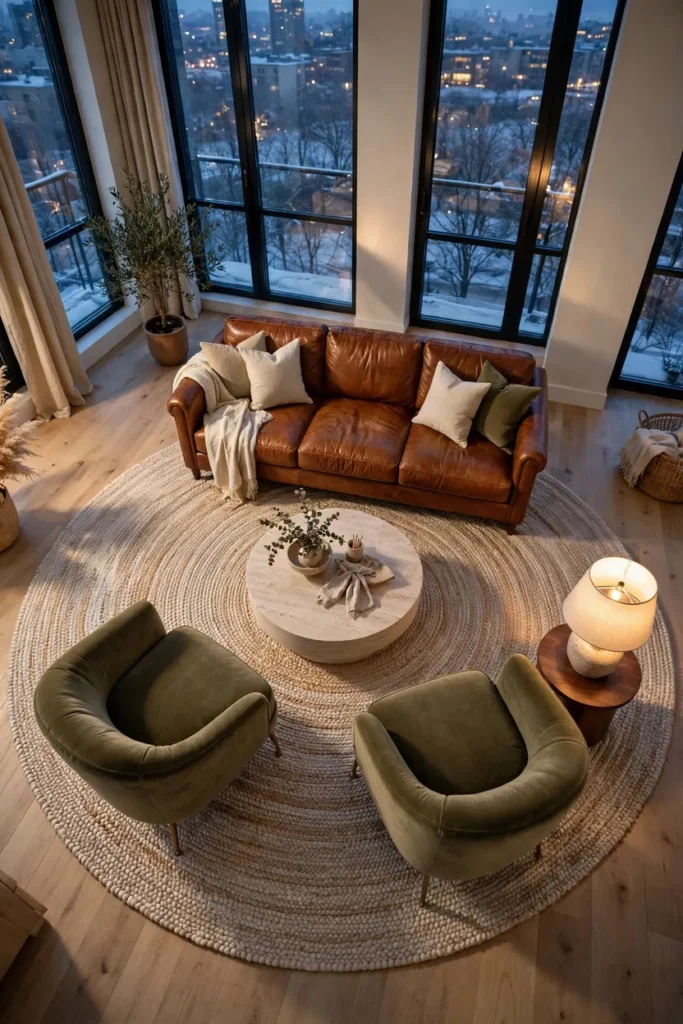
Sunken living rooms were a mid-century favorite because they made a room inside a room. You can get the same hug-like effect at floor level. Float the sofa away from the wall, face it toward two lounge chairs and set a large round rug under the group. Put a low round table in the middle. The circle of seating pulls people together, and the rug edge acts like the border of the old pit.
A Linear Fireplace Focal Wall
Fireplaces anchored many mid-century rooms, often as a long, low rectangle of stone or brick. An apartment can borrow the look with a slim plug-in electric fireplace in a wall unit. Wrap it in a soft charcoal paint or stone-look panels, then keep the mantel quiet with one ceramic piece and one print. Check your building rules and the unit’s power needs before you buy. One strong focal wall tells guests where to look and gives the sofa something to face.

A Sputnik Chandelier as Ceiling Sculpture
Light fixtures were small sculptures in this era. A Sputnik or starburst chandelier, with arms shooting out from a center, fills the empty ceiling in a room that has no other architectural detail. In a rental, choose a plug-in swag version with a ceiling hook and a cord cover that matches the finish. Brass or matte black with warm 2700K bulbs gives a soft glow. Hang it so the lowest point sits 30 to 36 inches above a table, or at least seven feet off the floor in an open walkway.

An Arc Floor Lamp That Draws a Line Over the Sofa
An arc lamp rises from a heavy base and bends over the seating like a branch. Designers loved it because it put light over a sofa or table without any ceiling wiring, which is exactly what renters need. Set the base behind the sofa arm or beside a chair, and aim the shade at the coffee table. Look for a marble or weighted base, a brass or chrome arm and a simple dome shade. The curve softens all the straight lines in the room and gives you a clean pool of reading light.

A Low-Profile Sofa With Visible Tapered Legs
Low furniture was a trademark of the era, and it suits apartments because it keeps sightlines open. Pick a sofa with a seat height around 16 to 18 inches, slim arms and legs that taper toward the floor. When you can see the floor under a piece, the whole room reads bigger. A wood frame or visible wood base adds a nice architectural line. Choose a tight-back or lightly tufted cushion in wool, bouclé or leather, in oat, cognac or olive.

A Pedestal Dining Nook
Pedestal tables free up legroom, which matters in a tiny dining corner. A tulip-style table has one central base, so chairs tuck in from every side. A round top between 36 and 42 inches wide seats two to four people. Add molded chairs with slim wood or metal legs, and hang a globe pendant over the middle. Leave about 36 inches of clearance behind each chair so people can pull out and still walk past. The round top also softens a corner and keeps everyone close.
Related: 16 Modern Farmhouse Dining Room Ideas That Just Work (Cozy + Practical)

Flat-Front Walnut Kitchen Doors With Brass Bar Pulls
Mid-century kitchens used clean slab doors, long handles and warm wood. You don’t need a full remodel to get the look. Try walnut-look door wraps or wood-grain peel-and-stick vinyl (ask your landlord first), then swap the pulls for slim brass bars. Measure the screw-hole spacing before you shop, and keep the old pulls to put back at move-out. Add a long-format white tile backsplash or a removable version, plus a globe pendant. The flat fronts and long handles make a strong horizontal rhythm that looks designed.

A Platform Bed With Floating Nightstands
A low platform bed with a simple wood frame sits close to the ground and keeps a bedroom calm. Pair it with wall-hung nightstands, or slim-leg ones if you can’t drill, so the floor stays visible. Add a slatted walnut-tone panel or a wide, shallow headboard behind the bed. Hang a pair of swing-arm wall lamps to free up the tabletops. The long, low lines echo the horizontal shape of mid-century houses and make the room feel restful.

A Terrazzo-Look Bathroom With a Wood Vanity Touch
Bathrooms of the era loved speckled terrazzo, small tiles and warm wood. In a rental, get that mix with a terrazzo-look peel-and-stick floor, a round mirror and a wood-toned shelf or vanity top. Add globe sconces, matte brass hardware and thick cotton towels in rust or olive. The speckles hide water spots, and the wood warms up cold tile. A round mirror also gives you one soft curve against all those straight edges.

An Entry With a Floating Console and Sunburst Mirror
The entry sets the mood for the whole apartment, even when it’s just a few feet of wall. Hang a narrow console about 8 to 10 inches deep, or use a slim-leg version, and add a small wood tray for keys. Place a sunburst mirror above it, a signature shape of the era that also bounces light into a dim hallway. Add a row of brass or wood hooks and a low walnut bench if you have space. In three square feet you get storage, a mini gallery and a bright welcome.

A Wall-Mounted Desk Niche
Mid-century homes often tucked a desk into a nook with a shelf above it. You can copy that in an apartment with a wall-mounted or slim floating desk, about 40 to 48 inches wide, in a walnut tone. Add one shelf above, a brass gooseneck lamp and a bentwood chair that slides under. The desk almost disappears when you’re done, so work doesn’t take over the living room. A clear niche also tells your brain it’s time to focus.

Oversized Abstract Art on a Calm Wall
One big, simple piece of art can make a plain wall feel like architecture. Choose an abstract print with bold shapes like arcs, circles or overlapping rectangles in your accent colors. Hang it so the center sits about 57 inches from the floor, which is the standard gallery height. Use a slim wood or black frame and a wide white mat. For lightweight frames, heavy-duty removable hanging strips save your walls. One large piece reads calmer and more confident than a crowd of small ones.

Layered Textures and a Geometric Wool Rug
Mid-century rooms feel warm because of texture, not clutter. Layer a wool geometric rug, a bouclé or nubby chair, a leather ottoman and a linen throw. Keep the rug pattern big and simple, like stripes, diamonds or overlapping circles in two or three colors. Size it so at least the front legs of the sofa sit on it, which usually means an 8 by 10 in a living room. Smooth walnut and cool glass next to rough wool gives the eye something to enjoy up close.

One Saturated Color Painted Into the Architecture
The era’s color was bold but rationed. Pick one hue, like olive, burnt orange, teal or mustard, and put it on a piece of the building: a door, a built-in or the wall behind the credenza. Keep everything else in warm cream, walnut and aged brass. Repeat the same color in two small accents, such as a pillow and a vase. When the color lives in the structure, it feels original to the apartment. If you can’t paint, lean a big painted panel against the wall. Test a sample in morning and evening light first.

Plants as Living Sculpture
Plants belong in mid-century rooms because they add organic curves against straight lines. Choose bold leaf shapes: a rubber plant, a fiddle-leaf fig, a snake plant or a monstera. Pot each one in a speckled ceramic planter and set it on a wood stand with tapered legs. Group them in odd numbers at different heights near a window. Match each plant to your light, and put snake plants in the dim corners. The wood stands repeat your furniture legs, which ties the plants to the style.

A Hi-Fi Listening Corner
Music was part of the design story in the mid-century era. Build a corner around a low console or credenza with a turntable on top and a pair of bookshelf speakers on slim stands. Keep records in a wood crate or a shallow rack. Angle a lounge chair toward the speakers and add a small side table for a drink. A rug and heavy curtains soak up echo. This gives the apartment a clear sit-and-listen zone, and the album sleeves double as colorful art.

A Balcony Treated Like an Outdoor Room
Indoor-outdoor flow shaped mid-century houses, and even a small balcony can follow the idea. Lay outdoor tiles or a flat-weave outdoor rug, then add a slim teak or acacia chair with a woven seat and a small round side table. Choose planters in simple geometric shapes. Repeat your indoor wood tone so the doorway feels like one continuous space. Add warm white string lights, and keep the door’s sightline clear so the balcony works like a picture frame for the room.

Styling Tips
These small rules tie all 23 ideas together, so the apartment looks planned instead of collected.
- Use a 60-30-10 color split. About 60 percent warm neutrals (cream, oat, soft white), 30 percent wood tones, and 10 percent your saturated accent plus brass.
- Keep the wood in one warm family. Walnut, teak and warm oak can share a room if the undertones all lean golden or red. Avoid pale, gray-toned wood next to them.
- Repeat one shape three times. A circle in the rug, the mirror and a side table does more than ten different shapes.
- Show the floor. Furniture on legs lets you see the floor, and that visible floor reads as extra square footage.
- Light at three heights. Use one overhead or arc source, one table lamp and one low accent lamp, all with warm 2700K bulbs.
- Leave some surfaces empty. Aim for about one-third of every shelf and tabletop to stay clear.
- Hang curtains high. Mount the rod or track close to the ceiling so the window looks taller.
- Mix old and new. One vintage piece, like a thrifted teak credenza, makes new items look less like a showroom.
Practical Implementation Ideas
You don’t need to do everything at once. This order works well for most apartments.
- Measure first. Write down wall widths, ceiling height, window sizes and door swings. Mid-century pieces are low and slim, so check clearances before buying.
- Fix the light. Add warm bulbs, an arc or table lamp and high-hung curtains. Light changes a room faster than furniture does.
- Pick one architectural move. Choose a slatted divider, a wood ceiling feature, a fireplace wall or a built-in-look credenza. Let it be the star.
- Add low, leggy furniture. Swap in a low sofa, a pedestal table or a slim credenza, one piece at a time.
- Layer color and texture last. Add the rug, the one bold color, art and plants once the shell is set.
Renter-safe moves (no permission needed): freestanding dividers, lamps, rugs, art on removable strips, plants, ceiling-track curtains on tension or clamp systems where allowed, and swapping furniture legs.
Ask your landlord first: painting, peel-and-stick cabinet wraps, replacing pulls, ceiling beams or plank panels, wall-hung nightstands, new fixtures and anything that needs screws in the wall.
Common Mistakes to Avoid
- Buying the whole set. A matching sofa, table and chairs from one line looks like a catalog. Mix three or four sources.
- Going full theme park. Orange, mustard, teal and avocado all at once feels costume-like. Pick one.
- Using shiny veneer and high gloss. Glossy finishes fight the calm, matte look of oiled wood.
- Choosing bulky pieces. Heavy, ground-hugging furniture hides the legs and the floor, which kills the airy feel.
- Ignoring scale. A 90-inch sofa in a 10-foot room blocks the walkway. Leave 30 to 36 inches of path.
- Using cool, bright bulbs. Blue-white light makes warm wood look flat. Stay with warm white.
- Hanging art too high. Keep the center near 57 inches from the floor.
- Hanging short curtains. Curtains that stop at the windowsill chop up the wall and shrink the room.
- Cluttering every surface. The style depends on negative space.
Small-Space Alternatives
Not every apartment has a spare wall or a high ceiling. Try these scaled-down versions.
- No room for a divider? Use a tall open bookcase with a wood back panel, turned perpendicular to the wall.
- Tiny living room? Swap the sofa for a loveseat with tapered legs and add two slim lounge chairs that you can push aside.
- No dining space? Use a 30-inch round drop-leaf table that folds against the wall.
- Low ceilings? Skip the beams and use a pale wood-toned strip along one wall, plus long vertical curtains.
- Narrow entry? Use a wall-hung shelf 6 inches deep with hooks below.
- Studio with one wall? Pick one focal wall, like the credenza wall, and keep the rest plain.
- Small bathroom? Choose a round mirror, one wood shelf and a rust or olive towel set, and nothing more.
- Tiny balcony? One chair, one planter and string lights are enough.
Budget-Friendly Alternatives
Prices vary by city and season, so use these as a rough guide to where to start.
Low cost (small spends, big effect):
- Warm 2700K bulbs and a thrifted table lamp.
- Brass bar pulls or knobs for flat-front doors.
- A big abstract print from a poster shop in a slim wood frame.
- Plants in ceramic pots on thrifted wood stands.
- Linen curtain panels hung high.
Mid-range:
- Tapered wood leg sets to swap onto a basic sofa, dresser or bench.
- A DIY slat screen made from furring strips and a simple frame.
- A wool geometric rug in cream and rust.
- A plug-in starburst or globe pendant.
- Peel-and-stick wood-grain film or terrazzo-look floor tiles, where allowed.
Splurge when it counts:
- A real walnut or teak credenza, bought secondhand from an estate sale, an online resale site or a local vintage dealer.
- A quality sofa, since it carries the room.
- An arc lamp with a real marble base.
High-low rule: spend on the pieces you touch every day, like the sofa and the bed, and save on decor and lighting.
Pro Styling Recommendations
- Pick one hero. Choose a single piece, like the slatted divider or the arc lamp, and build the room around it. Everything else should support it.
- Check the doorway view. Stand at the main entry and look at the room. The first thing your eye lands on should be your best piece.
- Use the rule of three materials. Wood, metal and a soft fabric cover most mid-century rooms. Add stone or glass as a fourth, not a fifth and sixth.
- Match bulb temperature. Keep every bulb at the same warm white so the wood tones look consistent at night.
- Take a photo of the room. A phone photo shows clutter and uneven balance that your eye skips.
- Echo lines on three sides. Repeat horizontal lines in the credenza, the shelf and the rug stripe so the room feels calm.
- Choose fewer, better accessories. Three ceramic pieces in related colors read stronger than ten in random ones.
FAQs
What is a mid-century modern apartment? It’s an apartment styled around the design ideas of roughly 1945 to 1975: clean lines, warm wood, low furniture, open layouts, big light and a few bold accents. In an apartment, it usually means borrowing architectural cues like slats, wood ceilings and high windows, not rebuilding the space.
How do I make my apartment mid-century modern on a budget? Start with light and layout. Add warm bulbs, a thrifted lamp, tapered legs on existing furniture, brass pulls and one big abstract print. Then save for one real wood piece, like a credenza.
Can I do mid-century modern in a rental without drilling or painting? Yes. Freestanding slatted dividers, arc lamps, rugs, plug-in fixtures, plants, wood stands and removable art strips give you most of the look. Peel-and-stick items and anything permanent need a landlord’s okay.
What colors work in a mid-century modern apartment? Start with warm cream, oat and white. Add walnut brown and aged brass. Then choose one saturated color, such as olive green, burnt orange, mustard or teal, and repeat it two or three times.
What woods are used in mid-century modern design? Teak, walnut, rosewood and oak are the classic choices. Walnut and teak are the safest for an authentic look, and oak works well in lighter, calmer rooms.
What are the main architectural features of mid-century modern design? Common features include post-and-beam construction, flat or low-pitched roofs, clerestory windows, floor-to-ceiling glass, open floor plans, built-ins, wood ceilings, wide eaves, breeze blocks and strong indoor-outdoor connection.
Related: 20 Modern Farmhouse Bathroom Ideas That Look Pinterest Perfect
Is mid-century modern still in style? Yes. The current take is warmer and calmer than the gray rooms of the last decade, with real wood used with restraint, layered lighting and a short list of materials.
How do I mix mid-century modern with other styles? Keep the lines clean and the wood warm, then bring in other elements in small doses. Scandinavian pieces, boho textiles or a modern sofa all blend well if the palette stays tight.
What is the difference between mid-century modern and Scandinavian style? Scandinavian design leans lighter, with pale woods and soft white spaces. Mid-century modern uses deeper woods like walnut and teak, stronger geometry and more saturated accent colors, though the two share a love of clean function.
How do I make a small apartment feel mid-century modern without clutter? Choose low furniture on legs, keep surfaces clear, stick to two or three colors and pick one architectural feature as the focal point. Fewer pieces with a clear shape feel more like the era than a crowded room full of decor.
Conclusion
You don’t need a 1955 house to get 1955 calm. You need a few good lines, a lot of warm light and a handful of honest materials.
Start with one idea from this list. Maybe it’s the slatted divider, maybe it’s just a high-hung linen curtain and a new bulb. Live with it for a week, then add the next piece.
Save the ideas that made you pause, and come back when you’re ready for the next layer. The best mid-century apartments aren’t finished in a weekend. They grow one clean, warm detail at a time.

